

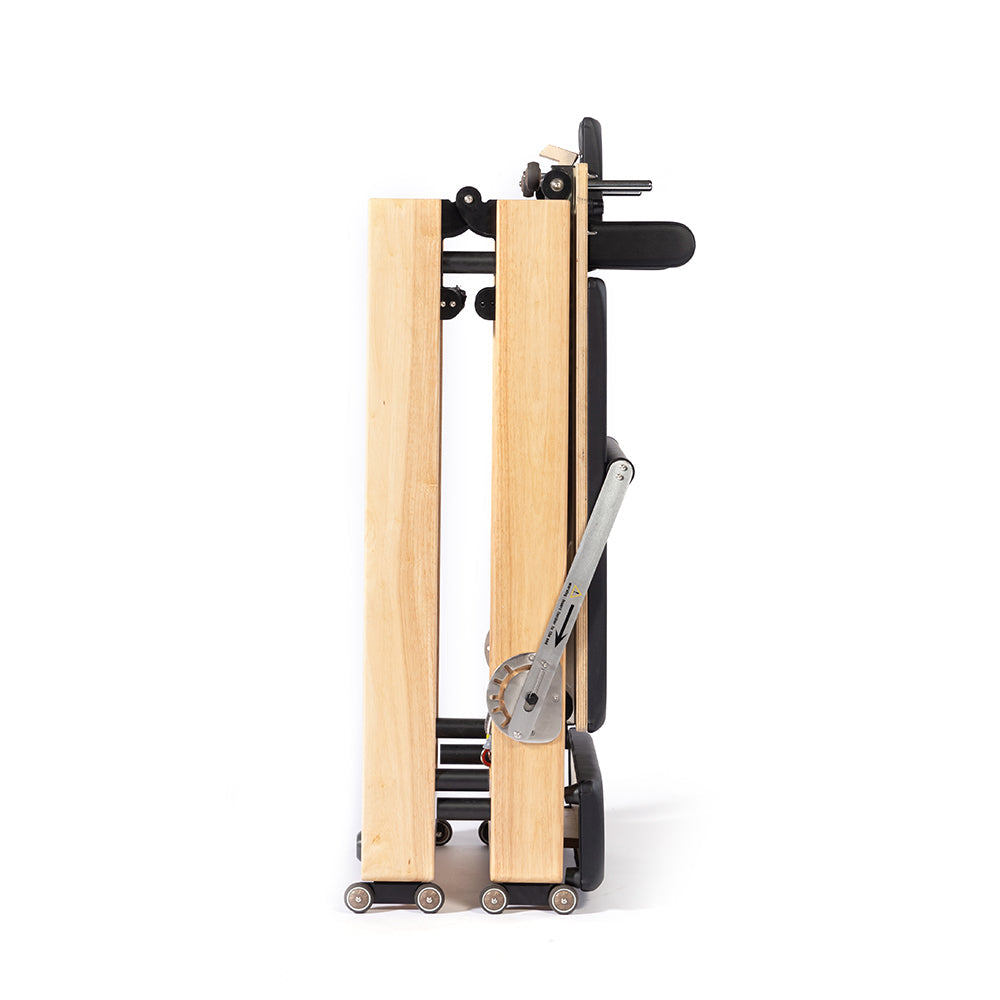
Living in an apartment doesn’t mean giving up serious Pilates training — it just means choosing smarter equipment. If you’re looking for a foldable reformer for small spaces, you’re already on the right path. This type of reformer is designed specifically for home users who need studio-quality movement without sacrificing their living area, making it one of the most practical home Pilates equipment solutions for compact homes.
The Real Challenge of Doing Pilates in a Small Apartment
You already know the problem. Traditional gym equipment is bulky, heavy, and hard to move. In an apartment, every square foot matters. Your living room might double as your workout space, and your workout space needs to disappear when guests come over.
Standard Pilates reformers — especially studio models — are built for permanent placement. They have a larger footprint, fixed frames, and are not meant to be stored away daily. That’s where a compact Pilates reformer changes everything. It’s not just smaller — it’s built around the reality of apartment living.
Before comparing individual models, use this practical guide on how to choose a Pilates reformer for a small space to measure both the workout footprint and the storage route.
What Makes a Reformer Apartment-Friendly?
Not all reformers work well in tight spaces. The best ones for apartments share several important design features:
1. Space-Saving Frame
A low-profile frame and streamlined structure allow the reformer to fit comfortably in smaller rooms without feeling overwhelming.
2. Easy Fold Mechanism
A true space-saving reformer is designed to fold smoothly without complicated steps. You should be able to transition from workout mode to storage mode quickly.
3. Vertical Storage Capability
This is critical. Being able to store the machine upright against a wall dramatically reduces the space it occupies when not in use.
4. Quiet Carriage Glide
In shared buildings, noise matters. A smooth, quiet carriage system lets you train early or late without disturbing neighbors.
5. Studio-Quality Resistance
Despite the folding structure, resistance should still come from a proper spring system that supports strength, control, and progressive training.
Foldable Reformer vs. Traditional Reformer
If you’re deciding between a standard model and a foldable one, here’s what really matters:
| Feature | Traditional Reformer | Foldable Reformer |
|---|---|---|
| Footprint | Fixed, larger | Compact, apartment-friendly |
| Storage | Stays in place | Can be folded and stored upright |
| Home practicality | Better for dedicated gym rooms | Ideal for multipurpose spaces |
| Training experience | Studio-style | Studio-style, home-optimized |
| Setup flexibility | Limited | Easy to move and reposition |
The key point: a foldable model isn’t a “lighter” version — it’s a home gym solution built for real living spaces.
Is a Foldable Reformer Stable Enough?
This is one of the most common concerns — and a reasonable one. You might assume that a folding structure means less stability. In reality, well-designed foldable models use reinforced frames and secure locking systems that keep the reformer solid during use.
Because resistance comes from controlled spring tension and guided carriage movement, the stability during exercises like footwork, bridging, planks, and core work remains reliable. For most home users, the training feel is very close to what you experience in a studio.
Where Do You Put It When You’re Done?
This is where apartment-friendly design really shines.
After your session, you can:
Fold the reformer
Position it vertically
Store it along a wall, in a corner, or behind furniture
Instead of dominating your living space, it becomes a piece of apartment workout equipment that adapts to your home — not the other way around.
Who Should Choose This Type of Reformer?
A foldable reformer is especially suitable if:
You live in an apartment or condo
Your workout area is also your living area
You want full-body Pilates training at home
You prefer long-term convenience over commuting to a studio
You need equipment that balances performance and storage
If you have a dedicated, large home gym, a non-folding studio model may make sense. But for most home users, the space-saving design is what makes consistent training realistic.
Cost Comparison: Home Reformer vs. Studio Membership
At first, a reformer feels like a big purchase. But compare it to ongoing studio costs.
Regular studio classes can add up quickly over months and years. With your own home Pilates equipment, you remove commute time, scheduling limits, and recurring class fees. Over the long term, a reformer designed for home use can become a more economical and flexible option.
More importantly, convenience increases consistency — and consistency is what actually delivers results.
FAQs
Is a foldable reformer good for beginners?
Yes. The guided carriage system and adjustable spring resistance allow you to start at a comfortable level and progress safely.
Does folding the reformer affect its durability?
Quality foldable models are built with reinforced joints and secure locking mechanisms designed for repeated folding and unfolding.
How much space do I need to use it?
You need enough floor space to extend the carriage fully during use, but storage space is minimal when folded upright.
Is the workout as effective as in a studio?
For most home users, yes. You can perform core work, lower-body strengthening, upper-body resistance, and flexibility training with studio-style movement patterns.
Can I move it by myself?
Most compact Pilates reformer designs are intended for home use, meaning they are manageable to reposition when needed.
A small apartment doesn’t have to limit your Pilates practice. With the right space-saving reformer, you get a balance of performance, convenience, and smart design — making consistent, full-body training part of your everyday home routine.
Share:
What Is a Pilates Cadillac?
BuyReformer Brand Logo Update Announcement