

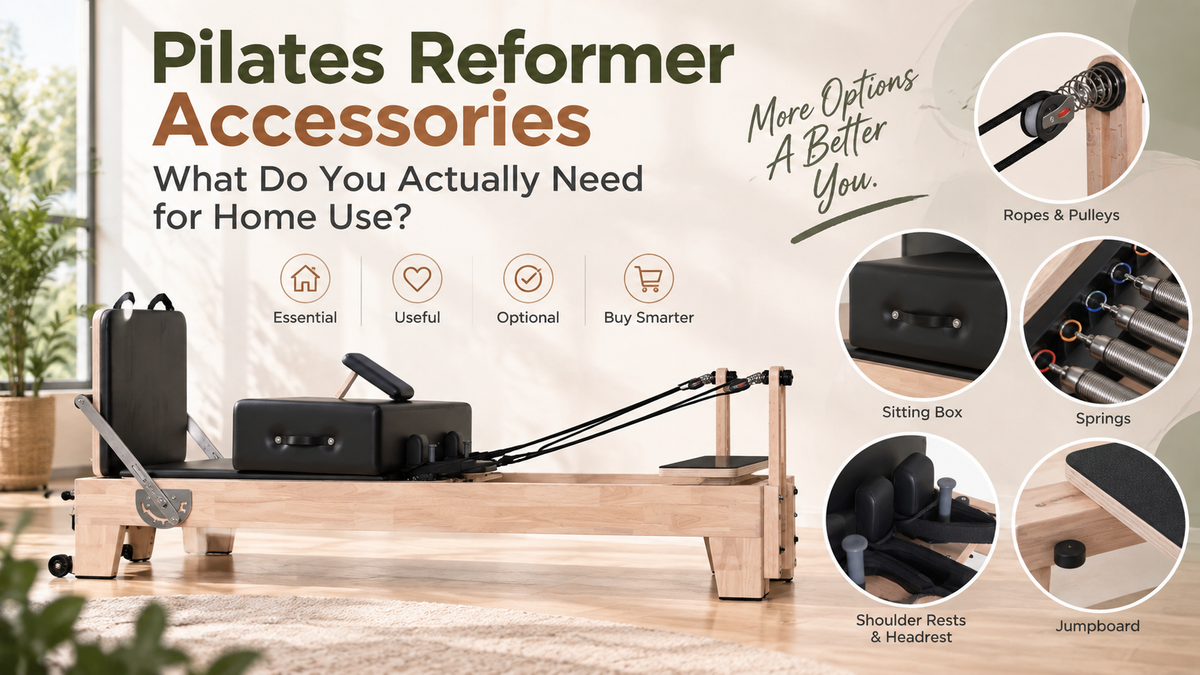
You probably need fewer Pilates Reformer accessories than you think.
If you are buying your first Reformer for home use, start by checking what comes with the machine. A sitting box and jumpboard can expand your exercise options, but you do not necessarily need to purchase them separately. Components such as ropes, shoulder rests and a headrest may already be part of the Reformer itself rather than optional extras.
For example, BuyReformer's BR Maple Pilates Reformer configurations include a box, jumpboard, headrest, shoulder rests and ropes with the machine. In a setup like this, buying another box or jumpboard immediately would usually make little sense unless you have a specific reason for needing a different one.
So instead of asking:
“What accessories should I buy for my Pilates Reformer?”
Start with:
“What is already included with the Reformer, and what will I actually use?”
That distinction can save you money, reduce unnecessary equipment around your home and give you a better idea of the real cost of your complete Reformer setup.
Quick Answer: Which Pilates Reformer Accessories Do You Need?
For most home users, you can think about Reformer equipment in four groups:
| Category | Examples | Do You Need It? |
|---|---|---|
| Core machine components | Springs, ropes, shoulder rests, headrest | Yes — normally part of the machine |
| High-value accessories | Sitting box, jumpboard | Useful, but depends on your training |
| Goal-specific accessories | Different loops, straps and compatible training additions | Only if you will use them |
| Small Pilates props | Ball, ring, resistance bands, light weights | Optional |
| Replacement parts | Springs, ropes, wheels and other wear components | As needed over time |
The biggest mistake is treating everything on this list as something you need to buy on day one.
You don't.
A better home Pilates setup starts with the Reformer and the equipment required for the exercises you actually plan to perform. You can add more later as your practice develops.
Before Buying Accessories, Check What Comes With Your Reformer
This should be your first step.
Two Reformers with similar prices may not represent the same overall value if one includes major accessories and the other sells them separately.
Before ordering, check the product specification for:
- sitting box;
- jumpboard;
- ropes;
- loops or handles;
- headrest;
- shoulder rests;
- springs;
- foot strap or related attachments where applicable.
You should also distinguish between an accessory and a component of the machine.
Springs, for example, are fundamental to how a spring-resistance Reformer operates. Ropes and shoulder rests are also integral to many Reformer exercises. Calling all of these “accessories” can make it sound as though you should shop for them separately when they may already be included.
A sitting box and jumpboard are different. Your Reformer can function without them, but they can expand the types of exercises available to you.
That is the distinction that matters when you are deciding what you actually need.
1. Do You Need a Sitting Box for Your Pilates Reformer?
You do not need a sitting box to use a Reformer, but it is one of the most useful additions if you want to expand your exercise repertoire.
A Pilates sitting box changes your position relative to the carriage. Depending on the exercise and your instruction, it can be used for seated, prone, side-lying and other movements.
It can also give you a raised and more defined surface for exercises that would otherwise be difficult or impractical directly on the carriage.
A sitting box makes more sense if:
- you regularly perform exercises that require one;
- you want a broader Reformer repertoire;
- your instructor or program uses box-based exercises;
- you want more positioning options on your machine.
You may not need to buy one immediately if:
- you are just beginning with basic Reformer exercises;
- your current program does not use a box;
- your Reformer already includes one.
That last point is easy to overlook.
If the model you are buying already comes with a sitting box, treat it as part of the total package value rather than adding another box to your shopping list.
2. Is a Pilates Jumpboard Worth It?
A jumpboard can be worthwhile if you actually plan to use jumpboard-based exercises.
It attaches at the foot end of a compatible Reformer and provides a larger surface for foot contact during exercises performed against the Reformer spring system.
That can introduce a different movement experience from conventional footbar work.
But a jumpboard is not automatically necessary just because it is a popular Reformer accessory.
Consider a jumpboard if:
- your home program includes jumpboard exercises;
- you have previously used one in Reformer classes and want that option at home;
- you want to expand beyond your standard footbar-based repertoire.
You can probably wait if:
- you are new to Reformer training;
- you are still learning foundational exercises;
- your program does not use a jumpboard;
- you are unsure whether it will become part of your regular practice.
And again, check the included equipment first.
Both the BR Maple Foldable Pilates Reformer and the fixed BR Maple Pilates Reformer configurations you are comparing already include a jumpboard. In that case, there is no need to calculate a separate jumpboard purchase into your initial setup unless you want an additional or different compatible board.
3. Headrest and Shoulder Rests: Accessories or Part of the Reformer?
For most buyers, it is more useful to think of the headrest and shoulder rests as components of the Reformer setup, rather than optional accessories you need to collect.
Shoulder rests help define your position on the carriage during many exercises. A headrest provides a designated support surface for the head where appropriate.
You should therefore check:
Are they included?
Are they adjustable or removable?
How are they padded?
How securely do they attach to the carriage?
Those questions are more useful than simply asking whether you should “buy” shoulder rests.
For example, the BR Maple Reformer configurations include a headrest and two shoulder rests as part of the supplied equipment.
That means your buying decision should focus on the design and usability of those components rather than budgeting for them as separate accessories.
4. Do You Need Extra Ropes, Straps or Loops?
Usually, not when your Reformer is new and already includes the ropes and handles required for normal operation.
Ropes are part of the Reformer's movement system, working with the pulleys and associated attachments during many exercises.
Your first priority should therefore be checking:
- what comes with the machine;
- whether the rope length can be adjusted appropriately;
- how the ropes attach;
- what type of loops or handles are supplied;
- how replacement ropes can be obtained later.
You may eventually prefer different handles, loops or straps for comfort or particular exercises, but that is a personal upgrade rather than a universal requirement.
Don't buy duplicates simply because they appear on an “essential Reformer accessories” list.
Use the equipment that comes with your machine first. You will make a much better accessory decision once you know what you actually like or dislike about the standard setup.
5. Do You Need Extra Pilates Reformer Springs?
Normally, no.
A new Reformer should come with the springs required for its intended resistance system.
Springs are not the same type of purchase as a sitting box or jumpboard. They are working components of the machine and should be treated accordingly.
Over time, springs need to be inspected as part of normal Reformer maintenance. If a spring shows rust, deformation, unusual wear, looseness or another abnormal condition, it may need replacement.
But you should not assume that buying more springs automatically gives you a better home setup.
Instead, before purchasing a Reformer, understand:
- the supplied spring configuration;
- the available resistance options;
- how the springs attach;
- how they should be inspected;
- whether compatible replacement springs are readily available.
This becomes increasingly important the longer you own the machine.
6. What About a Foot Strap?
A foot strap can be important for exercises designed to use one, but whether you need to purchase one separately depends on your Reformer design and what is already supplied.
As with ropes and loops, compatibility matters.
Don't assume that an attachment made for one Reformer will automatically fit another machine correctly.
Before adding one, check the manufacturer's specification and make sure the attachment is intended for your model.
This same rule applies to many larger Reformer accessories.
7. Do You Need Pilates Props With a Reformer?
Not necessarily.
Small Pilates props can add variety, but they are not required simply because you own a Reformer.
Depending on your program, you might eventually use:
- a Pilates ball;
- Pilates ring;
- resistance bands;
- light hand weights;
- grip socks;
- an exercise mat for off-Reformer work.
These can support particular exercises, but they shouldn't distract you from the reason you bought a Reformer in the first place.
If you are a beginner, it often makes more sense to become comfortable with the carriage, springs, footbar, ropes and basic Reformer movement before filling the room with additional props.
Add equipment because your training requires it—not because a checklist says your home studio looks incomplete without it.
8. Which Accessories Should a Beginner Buy First?
If you are a beginner, don't start by buying more accessories.
Start by learning what came with your Reformer.
If your machine already includes a sitting box and jumpboard, you may have more than enough equipment for a substantial range of exercises.
Your priorities should be:
First: understand your Reformer and its spring settings.
Second: learn safe carriage, footbar, rope and strap use.
Third: become comfortable with the included accessories.
Then: add equipment when your training creates a reason for it.
This approach is more useful than buying five accessories before your Reformer arrives and later discovering that you rarely use three of them.
If you are following an instructor, studio program or online training program, you can also use its exercise requirements to guide future purchases.
9. Which Accessories Are Worth Paying More to Have Included?
This is where accessories become part of the Reformer buying decision itself.
Imagine you are comparing two machines.
One has a lower advertised price but requires you to purchase the sitting box and jumpboard separately.
The other costs slightly more but already includes both.
You cannot determine which is better value from the machine price alone.
Instead, compare the complete setup cost:
Reformer + accessories you actually need + delivery + any required setup.
This is especially important when comparing Reformers across different brands.
A low starting price can look attractive until you add the equipment necessary to recreate the type of training you expected.
That doesn't mean the Reformer with more accessories is automatically the better purchase either.
Ten included extras have little value if you will never use them.
The goal is not:
Get the most accessories.
It is:
Get the right equipment at the right total cost.
10. Are Pilates Reformer Accessories Universal?
Do not assume they are.
This is particularly important for larger accessories and components that physically connect to the machine.
Reformers can differ in frame dimensions, carriage design, footbar construction, attachment points and other specifications. A box may physically sit on more than one machine, while a jumpboard or mechanical attachment may require a much more specific fit.
Before buying a third-party accessory, verify compatibility with your exact Reformer model.
This matters for:
jumpboards, replacement springs, ropes, wheels, hardware and other model-dependent components.
Compatibility is not just about whether you can physically attach something.
It also concerns whether the component functions as intended with the machine.
When in doubt, use accessories or replacement parts specified for your Reformer.
11. Don't Confuse Accessories With Replacement Parts
This distinction becomes more important after you have owned your Reformer for a while.
A sitting box is an accessory.
A worn rope is a maintenance item.
A jumpboard is an accessory.
A damaged wheel is a replacement component.
You should therefore think about long-term ownership in two separate budgets:
Training accessories
Things you add because you want additional exercise options.
Maintenance and replacement components
Things you may eventually need to replace because the machine is used and components wear over time.
For the BR Maple Reformers, for example, regular ownership includes inspecting springs for rust, deformation or looseness and checking ropes for wear or breakage.
Keeping the metal tracks clean and dry also matters to smooth carriage movement.
These maintenance requirements do not mean you need to buy spare parts immediately.
They mean you should know where compatible replacements will come from before you buy the machine.
That's a much better long-term buying question.
12. What Should Be Included With a Home Pilates Reformer?
There is no universal package that every Reformer must include.
But before ordering, you should know exactly what you are receiving.
For example, the BR Maple Reformer configuration includes:
- the Reformer frame;
- one sitting box;
- one jumpboard;
- one headrest;
- two shoulder rests;
- two rope posts;
- two ropes.
The BR Maple Foldable Pilates Reformer similarly includes the main frame, box, jumpboard, headrest, shoulder rests, rope posts and ropes.
That gives you a more complete picture than the machine price alone.
It also means that if you are comparing this configuration against another Reformer, you should compare equivalent setups rather than assuming every advertised price includes the same equipment.
13. A Better Way to Build Your Home Reformer Setup
Instead of buying everything at once, build your setup in stages.
Stage 1: The machine
Choose the right Reformer first.
Think about the frame, carriage movement, rails, spring system, footbar, machine dimensions, storage requirements and the space available in your home.
If you are still deciding how much room you need, our home Pilates Reformer space guide can help you plan around the machine rather than relying on the frame dimensions alone.
Stage 2: Use what's included
Learn the standard equipment before upgrading anything.
If your Reformer comes with a sitting box and jumpboard, use them before deciding you need alternative versions.
Stage 3: Add accessories around your training
Once you know which exercises you enjoy and perform regularly, accessory choices become much easier.
Stage 4: Plan for maintenance
Know how to inspect your springs, ropes, carriage system and other working components, and make sure compatible replacement parts are available when needed.
This gives you a home Pilates setup that grows with your practice instead of one built around impulse purchases.
So, Which Pilates Reformer Accessories Do You Actually Need?
For most home users, the answer is simple:
You need the components required to operate your Reformer safely and correctly. Beyond that, accessories should match the exercises you actually perform.
A sitting box can significantly expand your exercise options.
A jumpboard can be valuable if jumpboard training is part of your practice.
Different loops, straps and small Pilates props can add variety.
But none of this means you need to buy every accessory immediately.
Before spending anything extra, check what comes with your Reformer.
If the machine already includes a box, jumpboard, headrest, shoulder rests and ropes, you may already have most of what you need to start building a varied home practice.
Then let your training—not an accessory checklist—tell you what to buy next.
That approach gives you a cleaner home setup, a more realistic understanding of the total purchase cost and equipment that you are much more likely to use.
Frequently Asked Questions
What are the most useful Pilates Reformer accessories for home use?
A sitting box and jumpboard are two of the most useful larger accessories for expanding your exercise options, but whether you need them depends on your training. Check whether they are already included with your Reformer before buying them separately.
Do you need a Pilates box with a Reformer?
No. You can use a Reformer without a sitting box. However, a box allows additional positions and exercises, so it can be a useful addition if your program includes box-based Reformer work.
Do you need a jumpboard for a Pilates Reformer?
No. A jumpboard is optional rather than essential for normal Reformer operation. It is worth having if you plan to perform exercises designed around it. Some Reformers already include a jumpboard.
Do Pilates Reformers come with accessories?
It depends on the model and seller. Some are sold with a sitting box, jumpboard and other equipment, while others may require accessories to be purchased separately. Always check the “included in the box” specification before comparing prices.
Are Pilates Reformer accessories universal?
Not necessarily. Compatibility can vary by Reformer design and dimensions. This is especially important for jumpboards, springs, ropes and other parts that attach to or interact directly with the machine.
Should beginners buy Reformer accessories immediately?
Usually not. Start with the equipment included with your Reformer and learn how you use the machine. Add accessories later when a particular exercise or training goal gives you a reason to need them.
Should you buy spare Reformer springs and ropes?
You don't normally need to buy them immediately with a new Reformer. However, springs and ropes should be inspected regularly for wear or damage, and it is useful to know where compatible replacement components are available.
Share:
Pilates Chair vs Reformer: Which One Should You Buy for Home Use