

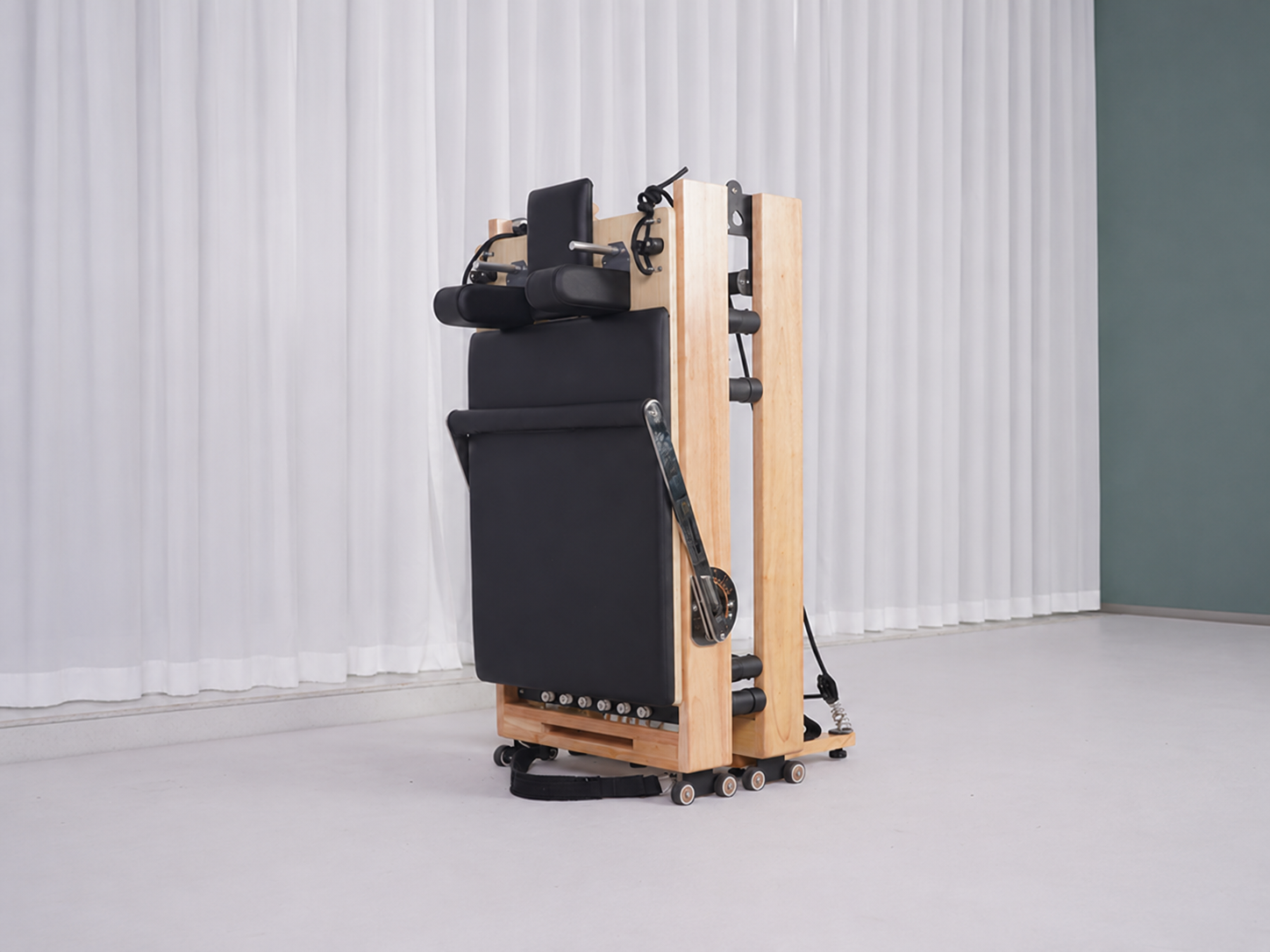
Gas Springs With Hydraulic Damping: The Engineering Behind Smooth, One-Person Folding in a Foldable Pilates Reformer
The design challenge of a foldable Pilates reformer is not simply whether the machine can be folded.
A reformer designed for regular workouts needs sufficient frame weight, structural rigidity, and stability during exercise. In a home environment, however, users also expect to be able to unfold and store the machine by themselves without continuously supporting a heavy frame or dealing with sudden upward movement, rapid lowering, uneven movement between the two sides, or potential pinch hazards.
This means that a folding system must perform three essential functions:
- Help the user balance the weight of the reformer frame.
- Control movement speed while the reformer is being folded or unfolded.
- Securely lock the frame through an independent structural locking mechanism once the reformer is fully unfolded.
The hydraulic folding system used in BuyReformer foldable Pilates reformers, also referred to as a hydraulic-assisted folding mechanism, is based on the following principle:
Gas springs with hydraulic damping are installed on both sides of the reformer frame. Their force and stroke are matched to the machine, and they work together with the frame hinges, mounting brackets, and structural locking mechanism as one complete folding system.
The pressurized gas inside each gas spring provides folding assistance. Hydraulic oil and internal flow restrictions control movement speed, while the symmetrical installation on both sides helps maintain balanced loading and synchronized frame movement.
The one-person folding experience offered by BuyReformer is therefore not produced by a single gas spring. It is the combined result of the gas springs, frame center of gravity, hinge locations, mounting angles, connection brackets, and mechanical locking structure.
1. What Is a Gas Spring With Hydraulic Damping?
A gas spring with hydraulic damping is a sealed mechanical component that combines spring assistance with controlled movement.
Its internal structure normally includes:
- A pressure cylinder;
- A piston rod;
- A piston assembly;
- Pressurized nitrogen gas;
- Lubricating and damping oil;
- Damping ports or restricted flow channels;
- Guide and sealing components;
- End fittings at both mounting points.
Within a foldable reformer mechanism, the component performs two separate but complementary functions.
1.1 Pressurized Nitrogen Provides Assistance
The pressurized nitrogen inside the gas spring produces a force that pushes the piston rod outward.
When the gas spring is installed between the folding reformer frame and the lower base frame, this linear force is converted into rotational torque through the mounting brackets and hinge points. It helps the user lift the frame or control it while lowering.
The purpose is not to raise the reformer automatically. Instead, the gas spring offsets part of the frame’s weight so the user does not have to continuously support most of the load.
1.2 Hydraulic Oil Controls Movement Speed
The hydraulic oil inside the gas spring must pass through damping ports or restricted channels in the piston.
When the reformer frame begins to move more quickly, the resistance created as the oil flows through these restricted passages also increases. This helps prevent sudden acceleration.
Hydraulic damping can therefore help reduce:
- The frame suddenly springing upward after being unlocked;
- The frame dropping too quickly during unfolding;
- Impact against the end stops near the end of the movement;
- Noticeable jumping or jerking during operation;
- A loss of control caused by abrupt changes in speed.
In simple terms:
The gas helps reduce the load, while the hydraulic fluid helps control the speed.
2. How Does a Gas Spring With Hydraulic Damping Work?
2.1 Gas Pressure Produces Extension Force
A gas spring contains pressurized nitrogen.
Because the piston rod occupies part of the effective area on one side of the piston, the two sides of the piston do not have the same effective pressure area. This difference creates a net force that pushes the piston rod outward.
Under simplified conditions:
Gas spring output force depends on internal pressure and the effective area of the piston rod.
As the piston rod is compressed farther into the cylinder, the available gas volume decreases and the internal pressure normally increases. A gas spring therefore does not necessarily produce exactly the same force at every position in its stroke.
In a foldable Pilates reformer, this changing force must be matched to the changing gravitational torque of the frame at different folding angles. This is necessary to create a smooth and manageable folding experience.
2.2 Hydraulic Oil Creates Resistance Through Restricted Flow
As the piston rod extends or compresses, the hydraulic oil inside the gas spring must move from one side of the piston to the other.
The oil creates resistance as it passes through the damping ports or restricted flow channels. A smaller flow path or higher oil viscosity generally produces greater resistance.
A hydraulically damped gas spring can therefore be designed with:
- Extension damping;
- Compression damping;
- Bidirectional damping;
- End-of-stroke damping;
- Longer-stroke damping;
- Damping optimized for a particular speed range.
It is important to understand that hydraulic damping does not always mean that the piston moves at exactly the same speed throughout the entire stroke.
Some gas springs provide stronger cushioning near the end of the stroke. Other designs provide damping over a longer section of movement. Actual performance depends on oil volume, piston design, mounting orientation, and the specifications of the gas spring.
2.3 Mounting Orientation Affects Damping Performance
Many gas springs are designed to remain with the piston rod pointing downward when the equipment is stationary or closed.
This orientation allows the internal oil to remain in contact with the sealing and guide areas, helping lubricate the piston rod and ensuring that hydraulic cushioning occurs in the intended direction.
However, gas springs do not all use the same internal design or damping direction. Users should not reverse the installation direction or swap the left and right gas springs without authorization. The original installation orientation specified for the reformer should always be maintained.
2.4 Temperature Can Affect the Folding Feel
Both gas pressure and hydraulic oil viscosity are affected by ambient temperature.
At higher temperatures:
- Internal gas pressure may increase slightly;
- Gas spring assistance may feel slightly stronger;
- Oil viscosity may decrease;
- Movement may become slightly faster.
At lower temperatures:
- Gas pressure may decrease slightly;
- Oil viscosity increases;
- Initial movement and folding speed may feel slower.
Minor seasonal changes in operating feel do not necessarily indicate gas spring failure. However, if the frame suddenly becomes much heavier, lowers too quickly, moves unevenly from side to side, or shows continuous oil leakage, stop using the folding mechanism and inspect it immediately.
3. Five Core Engineering Principles Behind Smooth One-Person Folding
3.1 Gas Spring Assistance Must Match the Gravitational Torque of the Frame
A foldable Pilates reformer is essentially a load rotating around a hinge axis.
The gravitational torque created by the reformer frame mainly depends on:
- The weight of the folding section;
- The location of the frame’s center of gravity;
- The distance between the center of gravity and the hinge axis;
- The current angle of the frame.
The assisting torque produced by the gas springs mainly depends on:
- Gas spring output force;
- Gas spring mounting angle;
- The distance between the gas spring’s line of action and the hinge axis;
- Gas spring extension or compression at the current frame angle.
All of these factors change continuously as the reformer is folded or unfolded.
A properly designed folding mechanism therefore cannot simply use the strongest available gas spring.
If the gas spring force is too low, the user will still need to support a substantial amount of frame weight. If the force is too high, the frame may have an excessively strong upward tendency after being unlocked, and the user may need to apply too much downward force while unfolding it.
An effective design must consider:
- Total reformer weight;
- Weight of the moving frame section;
- Frame center of gravity;
- Hinge position;
- Rated gas spring force;
- Effective gas spring stroke;
- Mounting-point locations;
- Starting and ending angles;
- The position where the user holds the frame;
- Consistency between the left and right gas springs;
- Friction in the hinges and connecting structures.
True folding assistance does not mean that the gas springs completely replace user control. It means that the user does not have to continuously support most of the reformer frame’s weight and only needs to hold and guide the frame along its intended path.
3.2 Hydraulic Damping Controls Speed but Does Not Replace Mechanical Locking
A folding system that provides assistance without sufficient damping may experience:
- Rapid upward movement immediately after unlocking;
- Excessively fast lowering during unfolding;
- Noticeable impact near the end of the movement;
- Difficulty maintaining control;
- Frame twisting caused by different movement speeds on the two sides.
The primary purpose of hydraulic damping is to restrict oil flow and reduce sudden acceleration of the reformer frame.
Hydraulic damping, however, is not the same as structural locking.
A standard gas spring with hydraulic damping mainly provides assistance and speed control. It does not normally guarantee that the frame will remain stationary at any angle.
Once a BuyReformer foldable Pilates reformer is fully unfolded, the frame is secured by an independent structural locking mechanism rather than being supported only by the gas springs.
This means:
- The gas springs balance the load and control movement speed;
- The hinges and brackets guide the movement path;
- The structural lock secures the fully unfolded frame;
- The user should continue holding and guiding the frame throughout folding and unfolding.
Separating these functions prevents the pressurized gas springs from being treated as the reformer’s only safety support.
3.3 Starting Angles and Mechanism Dead Points Must Be Carefully Managed
Many folding mechanisms experience shorter gas spring lever arms, sudden changes in starting force, or a change in movement tendency near the fully open or fully folded positions.
If a gas spring produces too much opening force while the reformer is closed, the frame may move upward too quickly as soon as the lock is released.
In contrast, if the gas spring’s line of action is too close to the hinge axis, it may provide insufficient assistance at the beginning of the movement. The user would then need to support a larger amount of weight before the gas spring begins to contribute effectively.
The design must therefore carefully establish:
- The fixed-end gas spring mounting position;
- The moving-end mounting position;
- Initial compression;
- The angle between the gas spring and the frame;
- The relationship between the frame’s center of gravity and the hinge axis;
- The fully unfolded and fully folded positions;
- Mechanical end stops and structural locking positions.
The engineering goal is not simply to eliminate every dead point. It is to prevent dangerous jumping, binding, and abrupt changes in starting force while maintaining stability at the end positions.
3.4 Dual Gas Springs Help Keep the Frame Balanced
BuyReformer’s hydraulic-assisted folding system uses a gas spring with hydraulic damping on each side of the reformer frame.
Compared with a single-sided arrangement, dual gas springs offer several important advantages:
- They share the reformer frame load;
- They reduce concentrated stress on a single mounting bracket;
- They help both sides move at a similar speed;
- They reduce frame twisting during folding;
- They improve the stability of a heavy frame while it is moving;
- They provide a more even operating feel for the user.
BuyReformer uses matching gas springs with the same specifications and corresponding mounting positions on both sides. They are matched as part of the complete mechanism according to the reformer’s weight, center of gravity, and folding geometry.
When the parts are in normal condition and the reformer is operated correctly, the two sides extend and compress together, helping the frame move smoothly without noticeable tilting.
Dual-sided installation does not mean that the reformer can continue to be used normally after one gas spring fails.
If one gas spring loses pressure, begins to bind, develops a loose connection, or has a damaged mounting bracket, the two sides will no longer share the load evenly. Stop folding or unfolding the reformer immediately if one side behaves abnormally.
3.5 One-Person Folding Is the Result of the Complete System
Gas springs with hydraulic damping are central components of the folding mechanism, but they are only one part of the complete system.
The actual folding experience is also affected by:
- Frame weight and center of gravity;
- Hinge location;
- Alignment of the left and right hinge axes;
- Frame twisting;
- Gas spring bracket strength;
- Whether the locking mechanism is fully released;
- Whether the carriage and footbar are in the required positions;
- Whether ropes or accessories interfere with the folding path;
- Floor levelness;
- Whether the user holds the frame at the designated location.
A more accurate description is therefore:
Gas springs with hydraulic damping that have been correctly force-matched, symmetrically installed on both sides, and integrated into the overall reformer structure can significantly reduce the load a user must support while controlling frame speed and enabling smooth one-person operation.
Simply adding a gas spring does not automatically create a safe folding mechanism.
4. What Is the Difference Between a Gas Spring With Hydraulic Damping and a Standard Gas Spring?
Many standard gas springs also contain a small amount of oil for seal lubrication and may provide limited cushioning near the end of the stroke.
The difference is therefore not simply that one type contains oil while the other does not. It is also inaccurate to assume that one type has damping while the other has none at all.
The most important differences are damping strength, damping distance, internal flow-path design, and the degree of movement-speed control.
| Comparison | Standard Gas Spring | Gas Spring With Hydraulic Damping |
| Primary function | Provides force, support, and load balancing | Provides load balancing together with more defined speed control |
| Internal oil | Normally contains a small amount of lubricating oil and may provide end cushioning | Oil volume, viscosity, and flow paths are selected for damping requirements |
| Damping range | Usually shorter and may be concentrated near the end of the stroke | Can be designed for longer-stroke, directional, or bidirectional damping |
| Movement speed | More heavily affected by gas pressure, load, and basic piston flow paths | Uses restricted flow to produce more predictable movement |
| Rapid-movement control | Relatively limited | Better suited to reducing sudden upward movement, rapid lowering, and end impact |
| Sensitivity to orientation | May affect lubrication and end cushioning | Can significantly affect damping direction and damping range |
| Holding at any position | Normally not possible | Also not guaranteed unless a lockable or positioning design is used |
| Typical applications | Lightweight lids and standard opening assistance | Heavy folding frames and equipment requiring smoother movement |
For a folding Pilates reformer, the main value of hydraulic damping is not to create stronger spring force. Its value is to provide assistance while making the movement smoother and easier to control.
5. Comparison of Common Folding Assistance Systems
| Folding Assistance System | Reduction in User Effort | Speed Control | Suitability for One-Person Operation | Main Limitations |
|---|---|---|---|---|
| Manual folding without assistance | The user supports the full operating load | Entirely controlled by the user | More suitable for lightweight equipment | Heavy frames are difficult to manage and may be difficult to control while lowering |
| Standard gas spring | Provides assistance and load balancing | Usually offers basic cushioning | Depends on frame weight and mechanism design | Speed may be inconsistent and end impact may still occur |
| Gas spring with hydraulic damping | Provides both assistance and controlled movement | Can be designed for specific directions and stroke ranges | Well suited to smooth one-person operation when correctly matched | Requires accurate matching of force, stroke, mounting angle, and hinge geometry |
| Electric folding system | The motor carries most of the operating load | Can be controlled electronically | Can be operated by pressing a button | More complex, requires power, and introduces additional maintenance costs and failure points |
For a home Pilates reformer that needs to be unfolded and stored regularly, gas springs with hydraulic damping offer several practical advantages:
- No external power supply is required;
- The mechanism is compact;
- Assistance and speed control are combined;
- The movement feels closer to natural manual guidance;
- The mechanism can be integrated into wooden or metal reformer frames;
- There are fewer electronic failure points than in a motorized system;
- It is well suited to living rooms, bedrooms, and multipurpose home spaces.
6. How Does BuyReformer Apply a Dual-Sided Hydraulic-Assisted Folding Design?
A well-engineered folding system should not merely allow a product to be described as foldable. It should reduce the practical effort required every time the reformer is unfolded and stored.
The hydraulic folding system used in BuyReformer foldable Pilates reformers combines:
- Gas springs with hydraulic damping installed on both sides of the frame;
- Gas spring forces matched to the frame weight and center of gravity;
- Symmetrically positioned mounting brackets;
- Hinges that guide the frame along its intended movement path;
- Mechanical end stops that limit the movement range;
- A structural locking mechanism that secures the frame when fully unfolded.
The BR Oak Foldable Pilates Reformer applies this system to a full-size wooden reformer designed to combine stable home workouts with more practical storage.
6.1 Dual-Sided Assistance Reduces the Load the User Must Continuously Support
A full-size foldable Pilates reformer must retain sufficient frame weight and structural rigidity to remain stable during exercise.
BuyReformer does not create folding capability by excessively reducing the weight of the reformer frame. Instead, gas springs on both sides help balance the frame load.
The user still holds and guides the reformer while folding or unfolding it, but does not have to continuously support a large proportion of the frame’s weight.
This makes the process feel more like guiding the reformer along a controlled movement path rather than directly lifting or holding the entire machine with the arms.
6.2 Hydraulic Damping Prevents Sudden Upward Movement and Rapid Lowering
Once gas springs begin providing assistance, the frame could still move too quickly without effective speed control.
The gas springs used by BuyReformer incorporate hydraulic damping. As the reformer frame moves, internal oil passes through restricted flow channels and creates resistance, helping control folding and unfolding speed.
When the gas springs, connecting structures, and locking mechanism are in normal condition and the reformer is operated according to the instructions, the system is designed to:
- Prevent the frame from suddenly springing upward after unlocking;
- Prevent rapid lowering during unfolding;
- Reduce impact near the end of the movement;
- Provide a more continuous and controlled operating feel;
- Give the user sufficient time to manage the frame position.
6.3 Synchronized Movement Reduces Frame Tilting and Twisting
Matching gas springs on both sides apply assistance to the left and right sides of the frame at the same time.
Compared with single-sided assistance, this dual-sided arrangement distributes the load more evenly and helps both sides of the reformer move together.
This is particularly important for a wide, substantial wooden Pilates reformer because uneven loading can cause:
- Frame tilting;
- Uneven hinge loading;
- Additional torque on the mounting brackets;
- Binding during folding;
- Loosening of connecting structures over time.
BuyReformer treats the left and right gas springs as one matched folding system rather than two independent support components.
6.4 A Structural Lock Secures the Reformer After Unfolding
Gas springs provide assistance and speed control, but they should not be the only support holding an unfolded reformer in position.
Once a BuyReformer foldable reformer is fully unfolded, a reliable structural locking mechanism secures the frame.
Before beginning a workout, the user should confirm that:
- The reformer frame is fully unfolded;
- The left and right connecting structures are properly positioned;
- The locking mechanism is fully engaged;
- The frame does not show abnormal movement or excessive play.
The Pilates reformer should only be used for exercise after the structural lock has fully engaged.
6.5 Balancing Workout Stability With Practical Home Storage
A common design conflict in folding reformers is that a frame that is too light may feel less stable during training, while a frame that is too heavy may be difficult to store.
BuyReformer’s design approach is not to sacrifice frame stability for folding convenience. Instead, the dual-sided hydraulic-assisted folding system helps manage the weight of a substantial reformer frame.
This allows the reformer to move between two practical states:
- Fully unfolded as a full-size reformer for regular Pilates workouts;
- Folded by one person after training to release more usable space in the home.
For home users, the real value is not simply that the reformer can fold. The folding feature must be smooth, understandable, and practical enough to be used after each workout.
7. How to Maintain Gas Springs With Hydraulic Damping
The gas spring itself is normally a sealed, self-lubricating component. It does not require users to disassemble it, refill the gas, or add oil.
Routine maintenance should focus on keeping the piston rod clean and inspecting the external mounting system.
7.1 Do Not Apply Oil to the Piston Rod
Do not spray or apply any of the following products to the gas spring piston rod or seal area:
- WD-40;
- Silicone spray;
- Grease;
- Machine oil;
- Rust-prevention oil;
- Cleaning solvents;
- High-concentration alcohol cleaners.
Additional lubricants can attract dust and contaminate the seal area. Some solvents may damage the sealing materials or remove the normal oil film from the piston rod.
7.2 Keep the Piston Rod Clean and Straight
Use a soft, clean, dry cloth to remove dust from the piston rod.
When damp cleaning is necessary, use a slightly damp soft cloth without corrosive cleaning chemicals, and dry the surface afterward.
Do not:
- Sand the piston rod;
- Grip the piston rod with pliers;
- Paint the piston rod;
- Attach tape or labels to it;
- Scrape dirt away with a hard object;
- Strike or bend the piston rod;
- Use the gas spring as a carrying handle.
Deep scratches, dents, or bending can damage the sealing system and lead to gas or oil leakage.
7.3 Inspect Mounting Brackets and Connecting Hardware
The gas spring body is generally maintenance-free, but the external mounting structure should be checked regularly.
Inspect:
- Mounting bolts for looseness;
- Pins and retaining clips for correct installation;
- Ball joints or clevis fittings for excessive play;
- Mounting brackets for bending or cracking;
- Wooden mounting areas for looseness;
- Left and right mounting points for symmetry;
- Gas springs for lateral loading during movement;
- Hinges for abnormal movement.
Gas springs are designed primarily to carry loads along the axis of the piston rod. Significant side loading can accelerate wear in the guide and sealing components.
7.4 Do Not Disassemble, Drill, or Repressurize a Gas Spring
A gas spring contains pressurized nitrogen.
Users must not:
- Open the gas spring cylinder;
- Drill into the cylinder to release pressure;
- Cut the piston rod or cylinder;
- Heat or burn the gas spring;
- Refill it with nitrogen;
- Weld the gas spring;
- Modify the end fittings;
- Install an unverified replacement component.
When a gas spring fails, contact customer support and replace it with a component that matches the original specifications.
7.5 Replacement Gas Springs Must Match the Original Specifications
A gas spring should never be selected only by appearance, color, or overall length.
At a minimum, a replacement must match:
- Rated output force;
- Fully extended length;
- Fully compressed length;
- Effective stroke;
- Cylinder diameter;
- Piston rod diameter;
- Damping direction;
- Damping distance;
- End-fitting type;
- Mounting orientation;
- Number of gas springs used in the system.
BuyReformer uses a dual-sided gas spring arrangement. If one side shows a noticeable loss of force, the other side should also be inspected to avoid a significant difference in loading between the two sides.
8. Daily Inspection Checklist for Gas Springs on a Foldable Pilates Reformer
Spend a few moments completing the following checks before folding or unfolding the reformer.
Before Folding or Unfolding
- No children, pets, or other people are close to the reformer frame.
- No furniture, walls, or other obstacles are within the folding path.
- The carriage, footbar, ropes, and accessories are in the positions specified in the user instructions.
- The mounting bolts on both gas springs are secure.
- The mounting pins and retaining clips have not moved or become detached.
- The piston rods are not bent, deeply scratched, or visibly corroded.
- The gas spring cylinders are not dented, cracked, or severely damaged by impact.
- The mounting brackets are not bent or cracked.
- The wooden frame around the mounting points is not loose or damaged.
- There are no oil drops or continuous leakage around the gas springs.
- The structural locking mechanism releases normally.
- Both sides begin moving at the same time.
- Fingers and other body parts are clear of hinges and pinch points.
During Folding and Unfolding
Guide the reformer slowly and confirm that:
- The frame does not suddenly spring upward.
- The frame does not lower too quickly.
- There is no noticeable binding or jumping.
- The left and right gas springs extend and compress at approximately the same speed.
- The reformer frame does not visibly tilt or twist.
- There is no continuous rubbing, impact, or metallic noise.
- Movement remains controlled near the fully unfolded or fully folded position.
- The structural locking mechanism is fully engaged after unfolding.
Stop Using the Folding Mechanism Immediately If:
- The frame feels noticeably heavier than before;
- The frame suddenly moves upward quickly after unlocking;
- The lowering speed becomes significantly faster;
- One gas spring appears much weaker than the other;
- The two sides no longer move together;
- The reformer frame visibly tilts during movement;
- A piston rod is bent or deeply scratched;
- Oil continues leaking from the gas spring seal area;
- A mounting bracket is cracked or deformed;
- Mounting bolts repeatedly become loose;
- The structural locking mechanism cannot fully engage;
- A gas spring or connecting component has suffered a severe impact.
A very thin and even oil film on the piston rod may sometimes result from normal internal lubrication and does not necessarily indicate leakage.
However, if visible drops or pools of oil appear together with reduced assistance, unusual movement speed, or unsynchronized operation, stop using the reformer and contact customer support.
9. Frequently Asked Questions
Can a Gas Spring With Hydraulic Damping Hold the Reformer at Any Angle?
Generally, no.
A standard gas spring with hydraulic damping is primarily intended to provide assistance and control movement speed. It is not the same as a lockable gas spring.
A BuyReformer foldable Pilates reformer is secured in its fully unfolded position by an independent structural locking mechanism. Users should not release the frame midway through folding to test whether it will remain at a particular angle.
Why Does the First Movement Feel Slightly Stiffer After the Reformer Has Not Been Folded for a Long Time?
A certain amount of static friction exists between the gas spring seals and the piston rod.
After the reformer has remained in one position for an extended period, slightly more force may be required to overcome this initial friction. Movement should then become smooth.
A minor increase in initial operating force does not normally indicate a fault. Stop using the system if there is severe binding, sudden jumping, or uneven movement between the two sides.
Why Does the Folding Feel Different in Winter and Summer?
Gas pressure and hydraulic oil viscosity change with temperature.
At low temperatures, the oil becomes more viscous and movement may be slightly slower. At higher temperatures, gas pressure may increase slightly and the mechanism may feel lighter.
Normal temperature-related changes should be gradual and controllable. A sudden loss of support or a significant increase in lowering speed is not a normal temperature effect.
Can I Spray WD-40 on the Gas Spring to Stop a Noise?
It is not recommended.
The noise may come from a hinge, mounting bolt, pin, mounting bracket, or another connection rather than from inside the gas spring.
Do not spray WD-40 or another lubricant directly onto the piston rod or seal area. Identify the source of the noise first and service the relevant mechanical connection according to the reformer instructions.
Do Gas Springs Need Regular Oil Lubrication?
Normally, no.
A gas spring is a sealed, self-lubricating component. The parts that require regular inspection are the external bolts, pins, hinges, brackets, locking mechanism, and frame connections.
Can a Failed Gas Spring Be Repaired?
Users should not attempt to repair, disassemble, or repressurize a gas spring.
If the gas spring shows a noticeable loss of force, continuous oil leakage, a bent piston rod, or abnormal movement, contact customer support and replace it with a component that matches the original specifications.
Why Must Both Sides Use Gas Springs With the Same Specifications?
The left and right gas springs share the reformer frame load.
If the two sides have different force ratings, lengths, strokes, or damping characteristics, the frame may move unevenly, tilt, or place unequal loads on the hinges.
A gas spring should never be replaced with a visually similar component of unknown specifications.
10. Everyday Practices That Help Preserve Smooth Folding Performance
To maintain stable and safe operation of the folding system:
- Before folding, move the carriage, footbar, ropes, and relevant accessories to the positions specified in the product instructions.
- Always hold the reformer at the designated frame location while folding or unfolding it. Do not pull directly on the ropes, footbar, or gas springs.
- Even though the reformer is designed for one-person operation, maintain control of the frame throughout the entire movement.
- Do not deliberately release the frame midway through folding to test whether the gas springs can hold it in place.
- Do not allow children to operate the folding mechanism, and keep children and pets away from the frame’s movement path.
- Do not force the reformer to fold while the locking mechanism is still engaged.
- After fully unfolding the reformer, confirm that the structural locking mechanism is completely engaged before beginning a workout.
- Do not rely on the gas springs as the only safety support.
- If the reformer has been moved, dropped, or subjected to an impact, inspect the gas springs, brackets, hinges, and locking mechanism before use.
- Do not paint, sand, grip, or apply lubricants or cleaning solvents to the piston rods.
Conclusion: A Mature Folding System Does More Than Make a Reformer Foldable
Gas springs with hydraulic damping are well suited to substantial folding Pilates reformers because they combine two functions in one compact, sealed component:
- Pressurized nitrogen provides assistance and reduces the amount of reformer frame weight the user must support while folding or unfolding;
- Hydraulic oil and restricted flow channels control movement speed and reduce sudden upward movement, rapid lowering, and end-of-travel impact.
BuyReformer’s hydraulic-assisted folding system installs gas springs with hydraulic damping on both sides of the reformer frame and combines them with hinges, mounting brackets, mechanical end stops, and a structural locking mechanism.
When the reformer is operated correctly and all components are in normal condition, the design can:
- Prevent the user from having to continuously support a large amount of frame weight;
- Control folding and unfolding speed;
- Prevent the frame from suddenly springing upward or lowering too quickly;
- Help the left and right sides move together;
- Secure the fully unfolded frame with a reliable structural lock.
When evaluating the folding design of a home Pilates reformer, it is therefore not enough to look for the words “hydraulic folding” or “gas spring.”
You should also consider:
- Whether the gas spring force is matched to the reformer weight and center of gravity;
- Whether the system uses dual-sided assistance;
- Whether the folding movement is smooth and controlled;
- Whether the frame can suddenly rise or drop;
- Whether the left and right sides move together;
- Whether an independent and reliable structural lock secures the fully unfolded reformer;
- Whether routine inspection and replacement of components are practical.
Correctly selected, dual-matched, and structurally integrated gas springs with hydraulic damping can transform the process from “lifting and lowering a heavy reformer” into “smoothly guiding the frame through folding and unfolding.”
That is the central goal of BuyReformer’s foldable Pilates reformer design: to preserve the stable workout experience of a full-size reformer while making unfolding, folding, and home storage feel more natural and controlled.
Explore the BuyReformer Foldable Pilates Reformer
When choosing a foldable Pilates reformer for home use, the folding mechanism is only one factor to consider. You should also compare the unfolded dimensions, folded dimensions, frame material, carriage movement, spring resistance system, leg height, and the amount of workout space available in your home.
Explore the BR Oak Foldable Pilates Reformer to learn more about its frame structure, dual-sided hydraulic-assisted folding design, dimensions, and included features, and determine whether it is the right space-saving Pilates reformer for your home training needs.
Share:
Gym Reformer Classes vs. Owning a Home Pilates Reformer: Which Is Right for You?
What Makes a Pilates Reformer Run Smoothly and Quietly?