

Introduction
A Pilates Reformer should provide a smooth, controlled, and quiet movement experience. However, after repeated use, transportation, repositioning, or long-term operation, some users may notice squeaking, creaking, clicking, or other unusual sounds.
A noisy Pilates Reformer does not always mean there is a serious mechanical problem. In many cases, the sound comes from simple causes such as:
- dust or debris affecting the carriage wheels and rails;
- loose external fasteners;
- spring attachment points moving under tension;
- rope and pulley friction;
- uneven flooring or frame stress;
- normal wear of moving components.
The key to solving a squeaky Reformer is not adding lubricant immediately. The first step is identifying when the sound happens and which system is producing it.
A Pilates Reformer is a complete mechanical system. Components such as the carriage wheels, bearings, aluminum rails, spring system, pulleys, ropes, and frame connections work together to create smooth and stable movement.
If you want to understand how these components contribute to a quiet and smooth carriage experience, read our guide on what makes a Pilates Reformer run smoothly and quietly.
This troubleshooting guide explains the most common causes of Pilates Reformer squeaking, what you can safely check, and when you should contact professional support instead of making adjustments yourself.
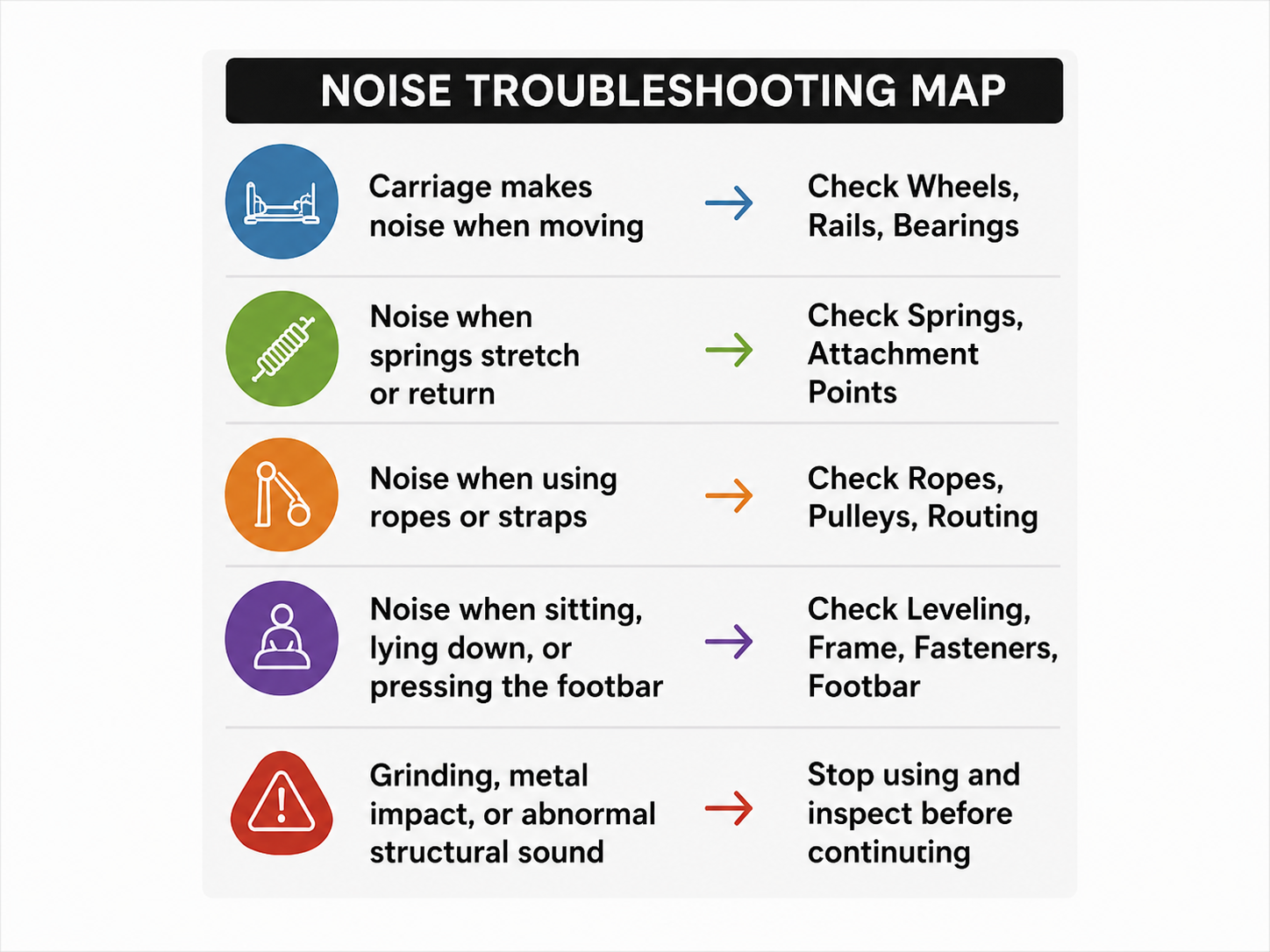
First: Identify When Your Pilates Reformer Makes Noise
Before cleaning, lubricating, or adjusting any parts, try to identify when the sound occurs.
Different situations usually point to different causes.
| When the noise happens | Possible causes to check |
|---|---|
| Carriage makes noise whenever it moves | Carriage wheels, rails, wheel assembly, bearings |
| Noise happens at the same point during every carriage movement | One specific wheel, wheel surface, or debris on the rail |
| Noise appears when springs stretch or return | Springs, spring attachment points, spring hooks |
| Noise appears only when using ropes or straps | Pulley system, ropes, rope routing |
| Noise appears when sitting, lying down, or pressing the Footbar | Frame connections, leveling, fasteners, Footbar |
| Clicking happens when changing movement direction | Loose connections, spring attachments, wheel mounting |
| Grinding, metal impact, or unusual structural sounds occur | Stop using and inspect before continuing |
A simple observation can save time:
- If the carriage is noisy without body weight, start with wheels, rails, and moving components.
- If the Reformer only makes noise when someone is using it, check frame stability, leveling, and connection points.
1. Loose Screws and External Fasteners
One of the most common reasons for a squeaking Pilates Reformer is a slightly loose connection point.
During regular workouts, a Reformer experiences repeated forces from:
- carriage movement;
- spring resistance;
- Footbar pressure;
- body weight changes;
- repeated assembly and adjustment.
Over time, some external fasteners may loosen slightly, especially after transportation or moving the equipment.
Common areas to inspect include:
- Footbar mounting points;
- Shoulder Rest installation points;
- Headrest adjustment components;
- Pulley brackets;
- External frame connections;
- Wheel fixing screws;
- Rope hook screws;
- Hinge fixing screws.
How to Check and Fix
If an accessible external screw or fastener is visibly loose:
- Use the correct tool for the fastener.
- Tighten it carefully until secure.
- Avoid excessive force.
Do not follow the rule:
“Tighten every screw as much as possible.”
Over-tightening may damage threads, wooden components, or hardware.
Some components, such as wheel alignment, bearing installation, or internal adjustment points, require correct positioning and should not be modified without proper instructions.
For BuyReformer products, users can inspect and tighten certain external fasteners, such as wheel fixing screws, rope hook screws, and hinge screws. However, internal mechanical adjustments should be handled according to product guidance or with support assistance.
2. Uneven Flooring or Incorrect Reformer Leveling
A surprisingly common cause of creaking sounds is not the Reformer itself, but the surface it is placed on.
If one support point does not fully contact the floor, the frame may experience slight twisting when weight is applied.
Typical signs include:
- The carriage moves quietly when nobody is on the machine.
- The Reformer creaks when someone sits, lies down, or presses the Footbar.
- The sound changes depending on where body weight is applied.
What to Check
Make sure:
- all feet are firmly contacting the floor;
- the Reformer does not wobble;
- leveling feet are correctly adjusted;
- the floor surface is stable and reasonably flat.
For long-term stability:
- avoid placing the Reformer on unstable soft surfaces;
- avoid temporary solutions such as thick towels that may compress or move during exercise;
- keep the equipment dry and away from environments with excessive humidity.
A stable frame creates better alignment between the carriage system, rails, and moving components.
3. Carriage Wheels and Rails: The Most Common Moving-System Check
If your Pilates Reformer squeaks whenever the carriage moves, the first area to inspect is the wheel and rail system.
Modern Reformers typically use carriage wheels that roll along rails rather than the carriage sliding directly against the metal track.
The carriage movement depends on the interaction between:
- carriage wheels;
- wheel bearings;
- rail surfaces;
- wheel mounting stability;
- overall frame alignment.
BuyReformer commonly uses high-elastic PU carriage wheels, bearings, and aluminum rails designed to provide stable carriage movement.
However, even a well-designed wheel system can become noisy if the contact surfaces are affected by:
- dust;
- hair;
- fabric fibers;
- small particles;
- transportation residue;
- surface contamination.
These contaminants can change the contact between the PU wheels and rails, resulting in:
- increased rolling noise;
- squeaking sounds;
- uneven movement;
- small vibrations.
How to Clean Carriage Wheels and Rails
Before applying any lubricant, clean the contact surfaces first.
Recommended steps:
- Stop using the Reformer.
- Wipe the aluminum rails with a clean, soft cloth.
- Remove visible dust, hair, or debris from accessible PU wheel surfaces.
- Check whether the wheel surface has unusual wear, cuts, or damage.
- Test the carriage movement again.
Keeping wheels and rails clean is one of the simplest ways to maintain smooth carriage travel.
Should You Lubricate the Rails?
Not every squeaking sound means the rails need lubrication.
A common mistake is assuming:
“The Reformer is noisy because the rails are dry.”
In reality, noise may come from:
- contaminated wheel surfaces;
- loose connections;
- worn components;
- spring attachment movement;
- pulley issues;
- incorrect setup.
For BuyReformer equipment:
- keep metal tracks clean and dry;
- if needed, apply a small amount of silicone lubricant according to maintenance guidance;
- remove excess lubricant after application;
- avoid over-lubrication, which may attract dust and affect the running surface.
Do not use:
- cooking oil;
- grease;
- unapproved lubricants;
- excessive amounts of lubricant.
The correct maintenance approach is:
Clean first → identify the source → lubricate only when appropriate.
4. Wheel Bearings and Wheel Assembly Problems
If you have already cleaned the rails and PU wheels but the Pilates Reformer still produces squeaking sounds during carriage movement, the next step is to check the wheel assembly and bearing system.
The carriage movement depends on several components working together:
- PU carriage wheels;
- bearings inside the wheels;
- wheel mounting structure;
- alignment between wheels and rails.
A problem with one component may affect the entire carriage experience.
BuyReformer Reformers are designed with high-elastic PU wheels and quality bearings to support smooth rolling performance. The wheel assembly is secured with a stable mounting structure to help maintain consistent carriage movement during repeated use.
However, like any mechanical component, wheels and bearings should be inspected over time.
Signs That the Wheel System May Need Attention
1. The sound appears at regular intervals during carriage movement
If the noise sounds like:
squeak → pause → squeak → pause
and the frequency changes as the carriage speed changes, the cause may be related to one specific wheel position.
Possible causes include:
- debris attached to the wheel surface;
- uneven wheel wear;
- surface damage;
- abnormal wheel rotation.
What to Check
Without removing the wheels, inspect:
- whether the PU wheel surface is clean;
- whether there are visible cuts, flat spots, or damage;
- whether any foreign material is attached;
- whether the carriage movement feels uneven.
2. Carriage movement feels unstable or has side-to-side movement
Noise combined with unusual carriage movement may indicate a wheel assembly or alignment issue.
Pay attention if you notice:
- excessive lateral movement;
- unusual vibration;
- uneven rolling resistance;
- carriage not traveling smoothly along the rails.
The wheel assembly, bearing condition, and mounting position all influence carriage stability.
For this type of issue, avoid adjusting wheel positions or disassembling bearings unless you have specific maintenance instructions for your model.
Incorrect adjustments may affect:
- wheel alignment;
- carriage stability;
- rail contact;
- overall equipment safety.
If a wheel does not rotate normally, the bearing appears damaged, or the carriage becomes unstable, contact BuyReformer support for further assistance.
5. Springs and Spring Attachment Points
If the carriage moves quietly but the noise appears when the springs stretch or return, the source may be related to the spring system.
The Reformer spring system includes:
- springs;
- spring hooks;
- spring attachment points;
- connection rings;
- mounting hardware.
Because springs repeatedly store and release resistance during workouts, they should be checked regularly.
Check the Spring Condition
Inspect springs for:
- rust or corrosion;
- visible deformation;
- damaged coils;
- unusual stretching behavior;
- abnormal sounds from a specific spring.
BuyReformer uses high-quality piano wire spring materials designed for consistent resistance and smooth extension.
A properly functioning spring should:
- stretch smoothly;
- return evenly;
- maintain its original shape;
- operate without unusual mechanical noise.
If a spring shows:
- significant rust;
- deformation;
- damaged coils;
- abnormal structural changes;
stop using that spring and replace it if necessary.
Do not continue using a damaged spring simply because the equipment still functions.
Check Spring Attachment Points
Sometimes the noise does not come from the spring itself, but from the connection point between the spring and the Reformer frame.
Possible symptoms include:
- clicking sounds;
- metal contact noise;
- rattling during movement;
- movement at the attachment point.
BuyReformer uses a secure spring attachment ring structure fixed with screws and nuts on applicable models. This design helps maintain a stable connection and reduce unnecessary movement during repeated spring loading.
However, if you notice:
- spring attachment ring movement;
- loose or damaged fixing hardware;
- deformation around the connection area;
- unusual metal movement;
stop using the equipment and contact BuyReformer support.
Do not attempt to:
- remove the spring attachment ring;
- modify the mounting structure;
- repair spring connection points yourself.
Spring attachment components are connected to a high-tension resistance system and should only be handled according to proper service procedures.
6. Ropes, Straps, and Pulley System Noise
If the carriage moves quietly but the Reformer becomes noisy when using ropes or straps, inspect the pulley system.
The rope and pulley system controls many upper-body and lower-body exercises. Smooth operation depends on:
- correct rope routing;
- pulley rotation;
- rope condition;
- connection points.
Common Causes of Rope or Pulley Noise
Possible causes include:
Incorrect rope routing
If the rope is not positioned correctly inside the pulley groove, it may rub against surrounding components and create noise.
Check:
- whether the rope follows the correct path;
- whether it contacts the frame;
- whether both sides move evenly.
Rope wear
Over time, repeated tension may cause:
- fraying;
- surface wear;
- broken fibers;
- uneven thickness.
Inspect ropes regularly for visible damage.
Because ropes are load-bearing wear components, BuyReformer recommends regular inspection and replacement based on condition and usage. For many users, replacing ropes annually is a recommended maintenance practice.
Pulley condition
A pulley that does not rotate smoothly may create squeaking or resistance.
Check:
- whether the pulley turns freely;
- whether dust or fibers are accumulated around the pulley;
- whether the rope moves smoothly through the groove.
If the pulley system requires service or a component replacement, follow the maintenance guidance for your specific Reformer model.
Do not apply large amounts of lubricant directly to ropes, upholstery, or unspecified pulley components.
7. Footbar, Headrest, Shoulder Rests, and Other Adjustable Components
Not all Reformer noises come from the carriage system.
Sometimes the sound comes from adjustable components that move under pressure.
Common areas include:
- Footbar adjustment mechanism;
- Headrest hinge;
- Shoulder Rest mounting points;
- locking pins;
- adjustment brackets.
How to Identify This Type of Noise
These sounds usually have specific patterns:
- no sound when the component is unused;
- sound appears when pressure is applied;
- sound appears only after changing the adjustment position.
For example:
- a Footbar may click if it is not fully locked into position;
- a Shoulder Rest may move slightly if not installed correctly;
- a Headrest may make noise if its adjustment mechanism is not secured.
What You Can Check
Confirm that:
- adjustable parts are installed correctly;
- locking mechanisms are fully engaged;
- visible external screws are secure;
- no foreign objects are trapped between contact surfaces.
Avoid applying oil or lubricant to upholstered areas or unknown contact surfaces.
8. Upholstery and Surface Material Noise
Sometimes users assume every squeak comes from mechanical components, but soft materials can also create sounds.
If the Reformer:
- moves quietly without body weight;
- only makes noise when someone lies down, turns, or changes pressure position;
the sound may come from upholstery contact.
Possible causes include:
- leather surface friction;
- padding compression;
- contact between upholstery and supporting structures;
- dust or debris between surfaces.
Upholstery Care
To maintain the leather surface:
- wipe after each use;
- use mild soapy water or a suitable leather cleaner;
- avoid harsh chemical cleaners;
- keep the surface dry after cleaning.
Do not apply oil, grease, or mechanical lubricants to leather, padding, or upholstery surfaces.
9. Should You Lubricate a Squeaky Pilates Reformer?
A common mistake is assuming:
“A noisy Reformer only needs more lubricant.”
This is not always true.
A squeaking sound may come from:
- contamination on wheels or rails;
- loose external fasteners;
- spring connection movement;
- rope friction;
- pulley issues;
- uneven flooring;
- component wear.
Lubrication may help in specific situations, but it should not replace proper diagnosis.
For BuyReformer equipment:
Metal Tracks
- Keep tracks clean and dry.
- If necessary, apply a small amount of silicone lubricant according to maintenance guidance.
- Remove excess lubricant after application.
- Avoid over-lubrication because it may attract dust.
Avoid Using:
- cooking oil;
- grease;
- random household lubricants;
- excessive amounts of lubricant.
The correct approach is:
Clean first → Identify the noise source → Apply maintenance only where appropriate.
10. When Should You Stop Using a Noisy Reformer?
Not every sound indicates danger.
However, some noises require immediate attention.
Stop using the Reformer and inspect the equipment if you notice:
- loud metal impact sounds;
- grinding or scraping sounds;
- suspected broken components;
- damaged springs;
- unstable carriage movement;
- loose wheel assembly;
- unusual movement from Footbar or other load-bearing parts;
- frame cracks or visible structural damage.
Do not continue exercising and attempt to “solve” these problems with lubricant.
Safety-related components should be inspected before further use.
11. Why Does My Pilates Reformer Make Noise After Installation or Moving?
Sometimes a Pilates Reformer may start making new sounds after:
- initial assembly;
- transportation;
- moving to a different room;
- repositioning on a new floor surface.
This does not automatically mean a component has failed. However, new sounds should be checked rather than ignored.
During transportation or movement, small changes may occur, such as:
- external fasteners becoming slightly loose;
- equipment position changing;
- leveling needing adjustment;
- dust or packaging residue affecting wheel and rail contact;
- adjustable components not being fully secured.
What to Check After Installation or Moving
Before regular use, confirm:
1. The Reformer is level and stable
Check that:
- all feet contact the floor firmly;
- the frame does not wobble;
- the equipment is placed on a stable surface.
An unstable base can create unnecessary stress on the frame and moving components.
2. External components are installed correctly
Check:
- Shoulder Rests;
- Footbar;
- Headrest;
- Rope and pulley connections;
- Spring connections.
Make sure all adjustable parts are correctly positioned and locked.
3. Wheels and rails are clean
During transportation, small particles or packaging materials may affect:
- PU wheel contact;
- rail surfaces;
- carriage movement.
Clean the wheel and rail surfaces before troubleshooting other possible causes.
4. Springs and ropes are correctly connected
Confirm:
- springs are attached properly;
- ropes follow the correct routing;
- straps and handles are correctly installed.
Incorrect installation can create unusual resistance or noise.
12. How to Prevent Pilates Reformer Squeaking
The best way to reduce future noise is not to wait until the equipment starts making sounds.
Regular inspection and proper maintenance help keep a Reformer operating smoothly.
Clean the Wooden Frame Regularly
For wooden Reformer frames:
- wipe the surface with a soft cloth;
- avoid chemical cleaners that may damage the finish;
- keep the frame dry.
Wood is a natural material and can be affected by:
- humidity;
- temperature changes;
- prolonged exposure to moisture.
Avoid storing the Reformer in environments with excessive humidity or direct sunlight.
Keep Leather Surfaces Clean
The upholstery is in direct contact with the user and should be maintained regularly.
Recommended care:
- wipe the leather surface after use;
- use mild soapy water or a suitable leather cleaner;
- remove sweat and residue;
- allow the surface to dry.
Avoid using mechanical lubricants or unsuitable cleaning products on leather surfaces.
Maintain Wheels and Metal Tracks
The carriage system depends on the interaction between:
- PU wheels;
- bearings;
- aluminum rails.
Recommended maintenance:
- keep rails clean and dry;
- remove dust, hair, and fibers from wheel contact areas;
- inspect PU wheel surfaces regularly;
- check for unusual wear or damage.
If necessary, apply a small amount of silicone lubricant to metal tracks according to maintenance guidance.
Avoid excessive lubricant because it may collect dust and affect wheel movement.
Inspect Springs Regularly
Springs are important load-bearing components.
Regularly check for:
- rust;
- deformation;
- unusual stretching;
- damaged coils;
- loose connections.
If a spring shows visible damage, replace it before continued use.
A damaged spring should not be repaired by bending, modifying, or attempting to restore its original shape.
Check Ropes and Replace When Needed
Ropes experience repeated tension during workouts.
Inspect regularly for:
- fraying;
- broken fibers;
- surface wear;
- abnormal stretching.
Because ropes are wear components, replacement should be based on condition and usage.
For many users, annual rope replacement is a recommended maintenance practice to maintain safe performance.
Store the Reformer Properly
When the equipment is not used for an extended period:
- avoid direct sunlight;
- avoid high temperatures;
- avoid humid environments;
- keep the equipment dry;
- maintain good ventilation.
Proper storage helps protect:
- wooden structures;
- leather surfaces;
- metal components;
- springs and hardware.
13. When Should You Contact BuyReformer Support?
Many basic issues can be identified through cleaning and inspection.
However, some situations require professional assistance.
Contact BuyReformer support if you notice:
- spring attachment ring problems;
- damaged or deformed springs;
- unusual movement of the spring connection structure;
- damaged wheel assembly;
- bearing problems;
- unstable carriage movement;
- frame damage;
- repeated noise after basic troubleshooting.
Especially for spring attachment points:
Do not remove, modify, or repair the spring attachment structure yourself.
The spring system stores significant tension, and incorrect handling may create safety risks.
Information to Provide When Contacting Support
To help identify the issue faster, provide:
1. Product information
Include:
- Reformer model;
- purchase information if available;
- approximate usage period.
2. Description of the sound
Explain:
- where the sound comes from;
- when it appears;
- whether it is continuous or intermittent;
- whether the sound changes with movement speed.
3. Usage conditions
Mention:
- whether the Reformer was recently moved;
- whether it was newly installed;
- whether the noise appeared suddenly;
- whether the equipment is used at home or in a studio environment.
4. Video of the issue
A short video showing:
- the movement causing the sound;
- the location of the noise;
- the carriage, spring, rope, or component involved;
is usually much more helpful than a written description alone.
Common Questions About Pilates Reformer Noise
Why is my Pilates Reformer squeaking when the carriage moves?
The most common causes include debris on the wheels or rails, wheel surface issues, bearing problems, or other carriage-related components.
Start by cleaning the PU wheels and rails, then check whether the noise continues.
Should I oil my Pilates Reformer rails?
Not always.
A squeaking sound does not automatically mean the rails need lubrication.
For BuyReformer equipment:
- keep metal tracks clean and dry;
- use a small amount of silicone lubricant only when necessary according to maintenance guidance;
- avoid excessive lubrication.
Always identify the source of the noise before applying any maintenance product.
Why does my Reformer squeak only when I sit on it?
If the Reformer is quiet when empty but makes noise under body weight, the cause may be related to:
- leveling;
- frame stress;
- external connections;
- Footbar or support structures.
Check that the equipment is stable and properly positioned.
Why does my Reformer spring make noise?
Spring-related sounds may come from:
- spring coils;
- spring hooks;
- spring attachment points.
Check for rust, deformation, or abnormal movement.
If the spring attachment ring or connection structure appears abnormal, stop using the equipment and contact support.
Final Summary: Find the Source Before Trying to Fix the Sound
A squeaking Pilates Reformer does not always mean a major mechanical failure.
The most effective troubleshooting method is:
Identify when the sound happens → Locate the possible component → Perform safe maintenance → Contact support when needed.
If:
The carriage makes noise while moving:
Check:
- PU wheels;
- rails;
- wheel assembly;
- bearings.
The springs make noise:
Check:
- springs;
- spring attachment points.
The ropes make noise:
Check:
- rope routing;
- pulley system;
- rope condition.
The noise appears only under body weight:
Check:
- floor stability;
- leveling;
- frame connections;
- Footbar.
The sound involves metal impact, grinding, or structural movement:
Stop using the equipment and request assistance.
A quiet and smooth Pilates Reformer depends on the combined performance of:
- high-quality wheels;
- reliable bearings;
- precise rail systems;
- stable spring connections;
- durable frame construction;
- proper maintenance.
For more information about the engineering behind smooth and quiet carriage movement, read:
What Makes a Pilates Reformer Run Smoothly and Quietly?
For long-term cleaning and care instructions, see:
Maintenance & Longevity of Wooden Pilates Reformers.
Share:
What Makes a Pilates Reformer Run Smoothly and Quietly?
Pilates Chair vs Reformer: Which One Should You Buy for Home Use