

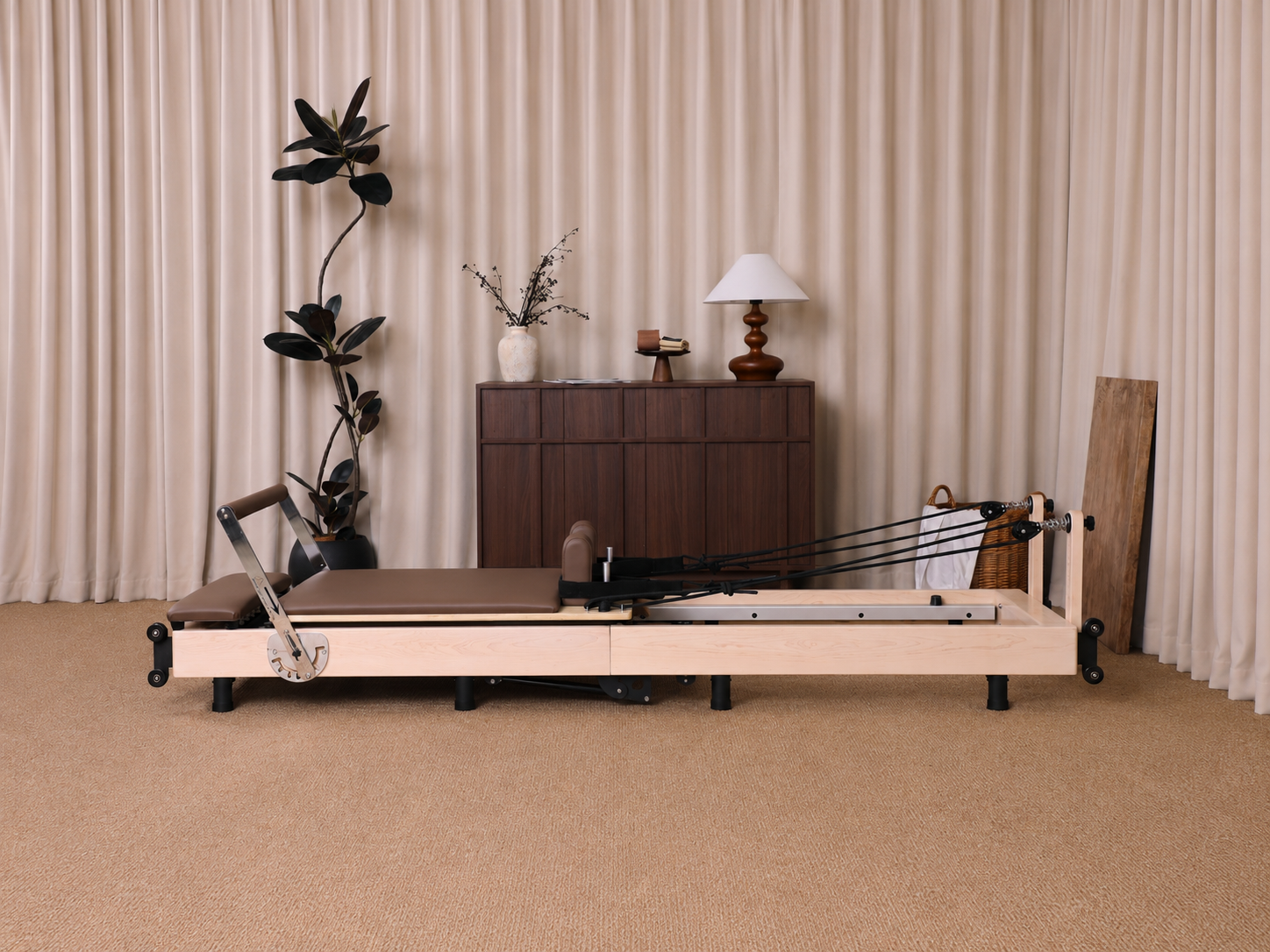
When you push the carriage of a Pilates Reformer in good condition, the ideal sensation should be smooth, stable, and feature natural variations in resistance—without any noticeable rolling, friction, metal clanging, or rattling noises.
This “smooth and quiet” experience is not determined solely by any single so-called “high-end bearing” or “silent guide rail.”
What truly influences the Reformer’s performance is a complete mechanical system:
The carriage wheel assemblies, bearings, rails, mounting structure, springs and their mounting methods, as well as the state of daily maintenance, all need to work together in harmony.
Understanding these factors can help you go beyond simply looking at the appearance, wood grain, or the “studio quality” claims in product advertisements when choosing a Reformer—allowing you to further assess why a piece of equipment can maintain smooth, quiet operation over the long term.
1. Pulley Assemblies: Much of the noise you actually hear originates from the contact between the wheels and the rails
The Reformer’s carriage does not slide directly on the rails; instead, it rolls along the rails via pulley assemblies mounted on the bottom or sides of the carriage.
Therefore, the material, elasticity, roundness, and installation condition of the wheels, as well as their fit with the rails, directly affect the feel of the carriage’s movement.
Why Are PU Wheels Commonly Used on Reformers?
BuyReformer’s main wheels typically use high-resilience PU (polyurethane) wheels, and some models feature high-resilience PU wheels specifically designed for low-noise operation.
Compared to very hard wheel surfaces, the slightly elastic PU surface can absorb some of the fine vibrations when the wheel contacts the track.
This means that as the carriage moves back and forth along the guide rails, some of the vibrations transmitted to the frame are reduced, thereby helping to minimize:
- Noise generated by wheel-to-rail rolling;
- Subtle vibrations;
- The jarring sensation caused when hard wheel surfaces pass over rail joints or minor surface irregularities.
It’s important to note that PU does not guarantee absolute silence.
The degree of wheel wear, the cleanliness of the track, whether the wheel assemblies are installed correctly, and whether the entire machine is level will all affect the final operating noise.
Therefore, a more important question than “what kind of wheels are used” is actually:
Whether the wheels, bearings, mounting structure, and guide rails are properly matched as a complete system.
2. Bearings: Important, but bearing grade alone does not determine whether the Reformer operates smoothly
The bearings inside the wheels are responsible for helping the wheel body rotate smoothly.
If the bearings are worn, contaminated, loose, or exhibit abnormal rotational resistance, users may feel increased resistance when moving the carriage, accompanied by rolling noises or periodic abnormal sounds.
BuyReformer’s product standards specify the use of C&U bearings with C0 standard internal clearance.
Here is a concept that is often confused by product marketing:
C0 is not a “high-precision bearing grade.”
C0 describes the standard internal clearance of a bearing; it should not be simplistically interpreted as “C0 is a higher-grade bearing than others” or “C0 means quieter operation.”
For the Reformer, the final user experience depends on:
Bearings + PU wheels + wheel assembly installation + guide rails + overall machine assembly
The combined result of all these factors.
Therefore, simply seeing a product labeled as having “premium bearings” or a specific bearing grade is not sufficient to conclude that its carriage will necessarily glide more smoothly.
3. Wheel Assembly Mounting Method: A Detail Rarely Noticed by Users, Yet One That Directly Affects Noises
Even if the wheels and bearings themselves are in good condition, if the wheel assembly is not securely mounted, prolonged back-and-forth movement may still result in:
- Minor displacement;
- Vibration;
- Rattling (noises caused by loose parts colliding);
- Slight deviations in the carriage’s direction of travel.
Therefore, the method used to secure the wheels is equally important.
According to BuyReformer’s structural standards, the main wheels are secured with a four-screw mounting system, ensuring the wheel assembly remains securely installed.
The purpose of this design is not simply to increase the number of screws, but to maintain the wheel assembly’s stability as much as possible during repeated stress cycles.
When the wheels are securely positioned, the geometric relationship between the track and the wheel assembly is easier to maintain, thereby reducing additional vibrations and mechanical noises caused by loose installation.
Thus, behind a quiet Reformer, there are often many structural details that are invisible to the user’s naked eye.
4. Aluminum Alloy Rails: It’s Not Just the Material That Matters—It’s the Consistency of the Rails and Their Assembly
Many Reformer manufacturers emphasize that they use aluminum rails.
However, “using aluminum alloy rails” alone does not directly guarantee that “the pulleys will glide very smoothly.”
The aluminum alloy rails used by BuyReformer are manufactured using an extrusion process.
The extrusion process creates continuous aluminum profiles, ensuring the rails maintain a relatively consistent cross-sectional shape along their entire length.
However, the carriage’s ultimate performance still depends on several factors:
Rail Surface Condition
The contact surface where the wheels actually run must remain intact and clean.
Dust, hair, small particles, and accumulated grime can all alter the contact between the wheels and the rails.
Rail Installation
Even if the rails themselves are well-machined, significant misalignment between the left and right rails during installation can still cause additional lateral forces when the wheel assemblies are in motion.
Frame Stability
The rails are ultimately mounted on the Reformer frame.
Therefore, the stability of the frame itself and the strength of its connections indirectly affect the relative position of the rails.
This is why, when evaluating the Reformer’s gliding experience, one should not focus solely on the statement:
“Aluminum rail.”
What really matters is the entire wheel–bearing–rail system.
5. Why is it not recommended to “oil” the Reformer rails indiscriminately?
When the Reformer begins to make noise, some users’ first reaction is:
Should I add lubricant to the rails?
In fact, this is not the correct approach for all Reformers.
On many Reformers, the carriage rolls along the rails on wheel assemblies rather than having metal parts slide directly along the rails.
Whether lubrication is needed, whether bearings or other moving parts should be lubricated, and which type of lubricant to use all depend on the specific product design.
Therefore, a more reasonable maintenance procedure should be:
- First, check the rails for dust, hair, or foreign objects;
- Check the surface of the PU wheels for obvious wear or damage;
- Check whether the wheel assemblies are loose;
- Determine whether any noises during carriage operation originate from the wheel assemblies, springs, or other connection points;
- Use the specified lubrication method only when explicitly required by the product’s maintenance instructions.
Do not apply regular machine oil directly to the track surface simply because the Reformer is making unusual noises.
Incorrect lubrication may actually attract more dust and particles, affecting subsequent operation.
6. Springs not only determine resistance but also affect the sound of the entire Reformer
Another major mechanical movement system in the Reformer is the springs.
When you push the carriage, the springs continuously go through the following cycle:
Extension → Maintaining tension → Retraction
Therefore, a spring in good condition should not only provide a stable resistance curve but also should not produce noticeable friction, scraping, or abnormal mechanical noises during normal extension and retraction.
BuyReformer’s springs are made from musical wire-grade spring material, including resistance springs crafted from musical wire sourced from brands such as Xiang and Wagner.
The focus with these springs is not simply on achieving “greater stiffness,” but on maintaining a stable mechanical state throughout repeated extension and retraction cycles.
For users, the key points to pay attention to are:
- Whether the extension is smooth and continuous;
- Whether the retraction is natural;
- Whether there are abnormal changes in resistance;
- Whether the springs show noticeable deformation;
- Whether unusual friction noises or metallic rattling occur during operation.
Therefore, “whether the springs are quiet” is essentially the result of the combined effects of spring material, manufacturing quality, connection structure, and operating conditions.
7. An Often-Overlooked Source of Noise: Spring Retaining Rings
Not all abnormal noises from springs originate from the springs themselves.
The connection points between the springs and the bed frame can also generate noise.
If the connection points shift slightly during repeated spring extension, the following sounds may occur between metal components:
clicking, rattling, or faint clinking noises.
Therefore, BuyReformer places greater emphasis on stability in the design of its spring mounting rings.
The spring mounting rings utilize a mechanical fastening structure consisting of screws and nuts.
The primary purpose of this structure is to maintain stability at the connection points under repeated spring loads, thereby reducing mechanical noises caused by loosening or unnecessary movement at the connection points.
Some conventional wooden Reformers use a combination of stainless steel and plastic components for spring mounting. Different mounting methods involve varying design trade-offs regarding ease of installation, maintenance, and disassembly, as well as connection stability.
BuyReformer’s design philosophy prioritizes:
Ensuring connection stability over the ability to disassemble quickly.
This means the mounting structure is not designed with quick disassembly in mind, but it provides a more stable mechanical connection during normal use.
For spring systems subjected to long-term, repetitive tension, this is a detail that is easily overlooked but can significantly affect mechanical noise.
8. The quality of the frame and assembly determines whether all components fit together properly.
Even if you have good wheels, bearings, rails, and springs, noise may still occur if the entire Reformer frame is loose.
Common issues include:
- Loose frame connection screws;
- Gaps at the footbar connection points;
- Shifts in the position of the rails;
- The bed is not level;
- Some connection parts becoming loose after prolonged use.
These issues typically do not produce a continuous rolling sound, but rather:
clicks, knocks, rattles, or periodic mechanical clattering.
Therefore, when a Reformer emits unusual noises, you should not limit your inspection to the wheels alone.
A more effective approach is to systematically troubleshoot based on the location of the noise and the phase of the movement.
For example:
If a continuous noise occurs while the carriage is moving,
it is worth inspecting the wheel assemblies, bearings, and tracks.
If a noise occurs when the spring begins to extend or retract,
it is advisable to further inspect the springs and their mounting points.
If a “click” sound occurs when changing the direction of movement,
inspect the connecting parts, spring attachment points, and other areas where play may be present.
This troubleshooting approach is generally more effective than simply “lubricating the machine.”
9. Cleaning and maintenance directly affect the operational condition of a Reformer
Even if a new Reformer is very quiet, you should not assume it will never need maintenance.
After prolonged use, the following substances may gradually accumulate near the tracks and wheel assemblies:
- Dust;
- Hair;
- Fibers;
- Sweat residue;
- Other fine particles.
These substances may adhere to the tracks or the surface of the PU wheels, altering the contact between the wheels and tracks.
Therefore, one of the most fundamental tasks for maintaining smooth operation is:
Regularly cleaning the tracks and wheel assemblies
- At the same time, you should also regularly check:
- Whether the PU wheels show abnormal wear;
- Whether the wheel assemblies are loose;
- Whether the springs are deformed or damaged;
- Whether the spring connection points are secure;
- Whether the ropes or webbing show signs of wear;
- Whether the pulleys rotate normally;
- Whether the frame and major connecting parts are loose.
The goal of maintenance is not to “fix noise” after a serious problem has arisen, but to identify minor issues before they develop into noticeable abnormal noises or operational resistance. Cleaning and maintenance directly affect the operating condition of a Reformer.
10. So, how is a truly smooth and quiet Reformer built?
From a mechanical standpoint, there is no single “silent component.”
Taking BuyReformer’s design standards as an example, smooth operation and low mechanical noise result from the combined action of multiple structural elements:
High-resilience PU main wheels
↓
Help absorb some of the minor vibrations caused by wheel-to-track contact
C&U bearings
↓
Help the wheels rotate stably
Four-screw wheel assembly mounting structure
↓
Ensures stable installation of the main wheel
Extruded aluminum alloy track
↓
Provides a continuous, consistent path for the wheel assembly
Spring retaining ring secured with screws and nuts
↓
Reduces unnecessary movement and impact at connection points
Music wire resistance springs
↓
Maintains continuous, stable extension, compression, and rebound during normal use
These components ultimately result not in isolated technical specifications, but in tangible benefits that users can truly experience:
Smooth carriage travel, stable resistance variation, and reduced unnecessary mechanical noise.
Need to confirm the specific configuration of a particular model
BuyReformer’s product pages primarily highlight the core configurations that influence purchasing decisions; therefore, some internal mechanical specifications are not listed item by item. Wheel assemblies, bearings, springs, or connection structures may vary by model. If a specific configuration is critical to your purchasing decision, please contact us before placing your order and let us know the exact Reformer model you are considering. Our customer service team can help you confirm details regarding the relevant wheel assemblies, bearings, guide rails, springs, and connection structures.
How can you tell if a Reformer truly operates smoothly?
If you’re comparing different Pilates Reformers, rather than relying solely on descriptions like “quiet,” “smooth,” or “studio-quality” on product pages, focus on a few more specific questions:
- What type of wheels are used on the pulleys?
- How are the wheels secured?
- Can the bearings and wheels be inspected or maintained?
- What is the structure of the guide rails?
- Is the resistance consistent as the pulleys move from one end to the other?
- Is there noticeable play or a jarring sensation when changing direction?
- Are there any unusual noises as the springs extend and retract?
- Are the springs securely fastened in place?
- Does the manufacturer provide maintenance instructions for key components such as pulley assemblies, rails, and springs?
These questions often provide a better indication of a Reformer’s actual mechanical design quality than any single, isolated specification regarding “high-end materials.”
Summary: Smoothness and quiet operation are, at their core, the result of the entire system working in harmony
Whether a Pilates Reformer can remain smooth and quiet over the long term is not determined by any single bearing, aluminum rail, or type of spring alone.
What truly matters is:
Whether the wheels roll smoothly, whether the bearings function properly, whether the wheel assemblies are secure, whether the rails are in good condition, whether the springs extend and retract smoothly, whether there is any unnecessary play at the connection points, and whether the entire machine is properly maintained.
This is why, when evaluating a Reformer, one should shift focus from simple material specifications to the coordination of the entire mechanical system.
For users, what ultimately matters is not a list of seemingly complex engineering specifications, but a Reformer that remains smooth, stable, predictable, and free of abnormal mechanical noise with every push-out and return stroke.
If you're comparing machines for home or studio use, you can compare Pilates reformers based on carriage design, dimensions, resistance systems and verified product specifications.
Share:
How Gas Springs With Hydraulic Damping Make a Foldable Pilates Reformer Easier to Fold
Why Is My Pilates Reformer Squeaking?