

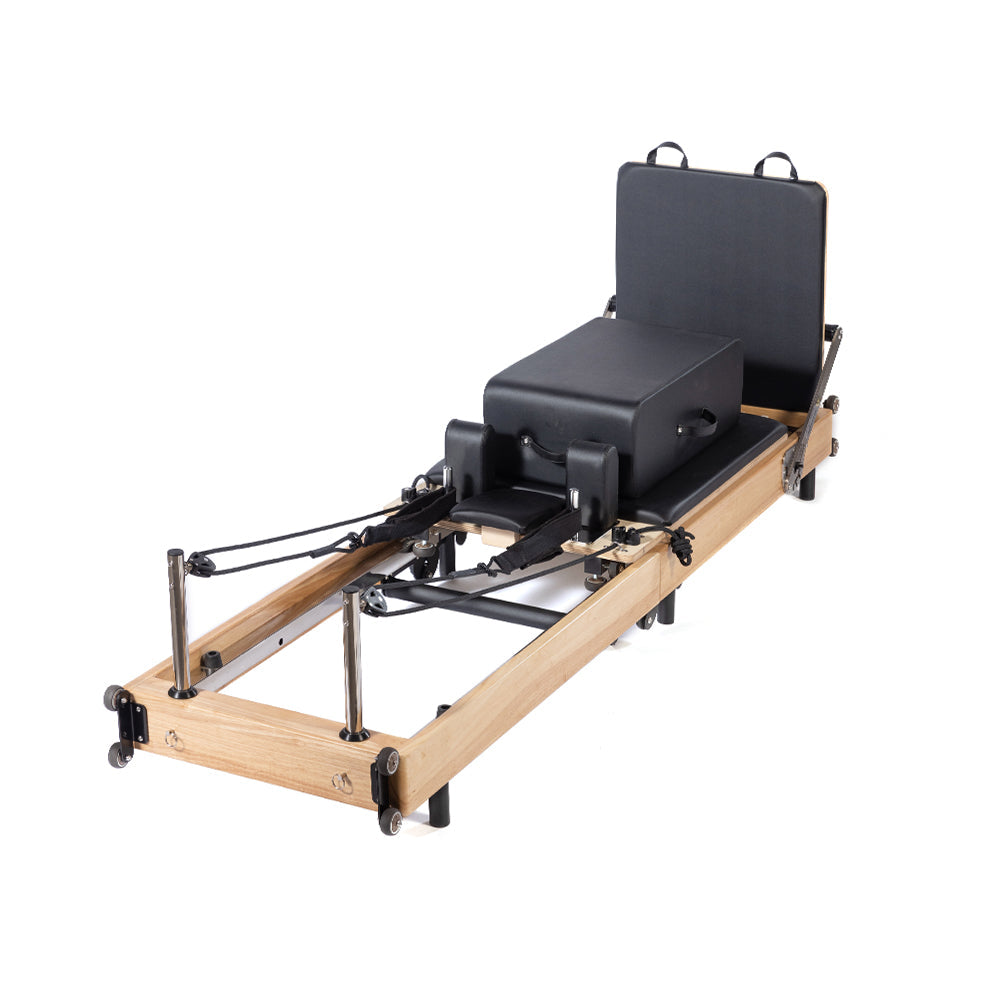
Why Most Beginner Pilates Reformer Advice Is Misleading (And the 10 Questions You Need to Ask)
Choosing your first Pilates reformer can feel like cracking a code. The internet is flooded with “best” lists and generic advice, but these recommendations often ignore one fact: the best reformer is always the one that fits your specific situation. Many seemingly standard beginner suggestions may actually lead you to purchase the wrong — or even unsafe — equipment.
Stop being confused by those “one-size-fits-all” claims. Through the 10 key questions below, we will clear away the fog and help you find the Pilates reformer that truly suits your body, living space, and goals.
Question 1: Is the length of this Pilates reformer truly suitable for my body?
You may hear: “Choose the bed length based on your height.” But this is an overly simplistic and misleading idea.
Why height alone is the wrong indicator
A person who is 180 cm tall may have short legs, while someone who is 165 cm tall may have long legs. What truly affects your movement quality and safety is your limb proportions, especially leg length.
Leg length, carriage travel, and footbar position explained
The key lies in carriage travel — the distance the carriage can move. When you lie on the carriage with your feet on the footbar performing leg exercises (such as “leg circles”), you need enough travel to allow full leg extension without your hips hitting the back frame. People with longer legs require longer effective travel.
Simple self-test: Sit on a chair and simulate fully straightening your leg. Measure the distance from your sit bones to your heel — this is roughly the minimum carriage travel length you need.
Who truly needs full-length rails — and who does not
Standard “full-length” rails (about 2 meters) are designed for studios and people with very long legs. Most beginners between 155–175 cm tall can fully meet their needs with a medium-length reformer (about 1.8–1.9 meters effective rail length), while saving space and budget. Unless you are over 185 cm tall or have particularly long legs, there is no need to insist on a “full-length” model.
If you fall into the 155–175 cm range and are building a home setup, a mid-length home Pilates reformer often provides the best balance between movement range, space efficiency, and long-term usability.
Question 2: Can I use a Pilates reformer in an apartment or upstairs room?
Of course, but you need to choose wisely.
Static load vs. dynamic load
Your floor cares about dynamic load — the impact forces and vibration produced by movement. A 50-kg reformer is safe when stationary, but when you jump or move quickly on the carriage, the dynamic force generated may be several times your body weight. The key lies in stability and force distribution.
Wood vs. aluminum: the truth about noise and vibration
• Wood: Heavier, usually absorbs vibration better, lands more solidly, but may produce friction sounds with the floor when moved.
• Aluminum: Lighter and easier to move, but some designs may produce greater metallic “clicking” sounds or vibration during fast movements. Choosing an aluminum reformer with strong structural rigidity and tight joints is key.
• Key point: A well-designed, solid reformer — regardless of material — is more neighbor-friendly than a poorly designed one.
If apartment living is your reality, prioritize a low-noise Pilates reformer with tight joint construction and smooth carriage glide rather than focusing only on weight.
Floor protection and anti-vibration mats
This is essential, not optional.
1. Professional exercise mat: At least 6–8 mm thick, covering the entire machine and exercise area. It cushions impact, protects the floor, and reduces noise.
2. Anti-vibration/soundproof mat: For apartments especially concerned about vibration, add a dedicated isolation mat under the exercise mat. Placing the reformer in a corner (near load-bearing walls) can also reduce vibration transmission.
For compact urban homes, foldable or mid-length reformers are often more practical without compromising stability.
Question 3: Do beginners really need a Pilates reformer with a tower?
A tower provides vertical spring training possibilities, but is it necessary for beginners?
What beginners actually use in the first 6 months
The vast majority of beginner classes focus on foundational carriage exercises: leg series, abdominal series, arm series, back extension. These core toning, flexibility, and awareness-building movements do not require a tower. In the first 6–12 months, 90% of your time may be spent working with the carriage, springs, and straps.
When a tower becomes worthwhile
When you:
• Have mastered foundational exercises and desire more upper-body strength (such as pull-ups) and spinal mobility (such as cat stretch) training.
• Need more comprehensive spinal correction and stretching options.
• Your training plan begins to include more classical Pilates “full apparatus” repertoire.
At that point, the tower shifts from “decoration” to “powerful tool.”
Who should temporarily skip it
• Those with limited budget: the tower significantly increases cost and space usage. Prioritize investing in a higher-quality base reformer (better wheels, smoother bearings, more durable frame).
• Those with tight space: the tower greatly increases vertical and horizontal footprint.
• Pure beginners: first ensure you love and will stick with the practice, then consider upgrading. Many brands allow later tower installation.
Invest first in a high-quality base reformer with a smooth carriage system and reliable springs. Many models allow future tower installation when you are ready to progress.
Question 4: Spring resistance — how beginners avoid joint overload
“Start with the lightest spring” is a common but dangerous suggestion.
Why “light” does not necessarily mean safer
The core role of springs is to assist and support, not only to create resistance.
• Too light: may cause joints (such as shoulders and knees) to become over-mobile, lose stability, and prevent proper muscle activation, potentially harming joints.
• Too heavy: leads to compensation and use of the wrong muscle groups.
The correct spring tension should provide controlled resistance and support at the beginning, middle, and end of a movement.
Body weight × movement pattern × spring setup
There is no “standard” setup. It depends on:
1. Your body weight and strength: heavier individuals or those with more muscle mass usually require stronger springs for sufficient support.
2. Movement pattern:
◦ Push (e.g., feet on footbar pushing) usually requires heavier springs to stabilize the trunk.
◦ Pull (e.g., arms pulling back) depends on training goal (strength or endurance).
◦ Support (e.g., plank) requires springs heavy enough to prevent excessive sinking.
• Beginner golden rule: Under professional instructor guidance, find the spring setup that allows you to complete full-range movement smoothly and with control.
Reformers equipped with 5-spring systems typically offer finer resistance adjustment than 3-spring entry models, which can be especially valuable for long-term progression and joint-friendly training.
Common beginner mistakes that cause pain
• Locking joints: hyperextending knees when legs straighten. Keep a slight knee bend.
• Shoulder tension: shrugging shoulders toward ears during arm work. Keep shoulders depressed.
• Ignoring the core: pulling the carriage with brute arm or leg force instead of initiating from the core. Imagine drawing your navel toward the spine.
• Moving too fast: using momentum. The core of Pilates is control — slow, mindful movement.
Control is the foundation of safe training.
Question 5: Are foldable Pilates reformers stable enough for long-term use?
Modern design makes many foldable reformers excellent, but the definition of “stable” needs examination.
What makes a foldable reformer stable (or unstable)
• Hinge design: high-quality reformers use strong metal hinges and locking pins that integrate with the frame when opened, offering rigidity comparable to fixed reformers.
• Frame weight and structure: even when foldable, the main frame should be heavy and solid.
• Additional support in open position: extra support legs or locks should ensure no movement once fully opened.
Scenario Insight: When Foldable Reformer Designs Become the Best Home Pilates Reformer Choice
For home users balancing training consistency and space management, a foldable Pilates reformer for small spaces can often provide the ideal compromise between studio-level function and residential practicality. Many modern designs now focus on maintaining structural rigidity while allowing compact storage, making them especially suitable for apartment users or multi-purpose workout rooms.
Crucial locking mechanisms
Before purchasing, research and test:
1. Locking type: simple spring pins or manually inserted solid metal pins? The latter is usually more reliable.
2. Number of locking points: at least two main locking points.
3. Clear indication: visual or audible cues (such as a “click”) confirming full lock. Must be checked before every use.
Who foldable reformers are not suitable for
• Those frequently performing high-intensity dynamic jump training.
• Those extremely sensitive to any slight movement.
• Those planning dual-user training or heavier load use.
For most home beginners, a well-designed foldable reformer achieves a perfect balance between stability and convenience.
Question 6: Wooden vs. aluminum reformers — the real beginner experience
This is not about which is “better,” but which feeling suits you.
Stability vs. feedback
• Wood (usually oak or maple):
◦ Feeling: more grounded and solid, with a rooted sense of stability. Feedback is slightly softer.
◦ Psychological: many people enjoy its classic, warm texture.
• Aluminum:
◦ Feeling: more direct, clearer feedback, allowing more sensitive perception of carriage movement and spring tension.
◦ Feature: usually lighter, easier to move; modern aesthetic.
Experience Matching Guide
Users seeking a studio-quality Pilates reformer experience at home often prioritize grounded movement feedback and vibration absorption, while users focusing on mobility, relocation flexibility, or modern design aesthetics may prefer lightweight aluminum structures with refined carriage responsiveness.
Why beginners often feel “safer” on wooden reformers
The extra weight and grounded feeling provide psychological and physical support, especially during balance-challenging exercises, making the machine feel more “reliable” and reducing anxiety about equipment movement.
If stability confidence is your top priority, a solid wood-frame Pilates reformer may offer a more reassuring beginner experience.
Maintenance truth
• Wood: avoid extremely dry or humid environments to prevent cracking or warping. Clean with a slightly damp cloth, avoid chemicals. High-quality wooden reformers are not difficult to maintain.
• Aluminum: almost maintenance-free, corrosion-resistant, easy to clean. Check surface treatment; low-quality coatings may peel.
Suggestion: if possible, try both materials in a showroom or studio. Your body will tell you the answer.
Which Type of Reformer Fits You Based on Your Situation?
Before continuing, pause and identify your category. Choosing the right Pilates reformer depends on your living space, long-term goals, and physical condition.
| If you… | Consider… |
|---|---|
| Live in an apartment | Wood-frame or low-noise aluminum reformer |
| Have limited space | Mid-length or foldable Pilates reformer |
| Want long-term progression | 5-spring professional system |
| Are recovering from injury | Smooth-glide carriage + adjustable headrest |
| Prefer studio-like stability | Solid wood frame with wide rails |
Identifying your situation first prevents beginner mistakes and helps you choose a best home Pilates reformer aligned with both your environment and your long-term training goals.
Question 7: How much space do you really need?
It’s not only about the dimensions needed to place the reformer.
Minimum safe space categorized by movement type
• Basic carriage movements: Leave at least 30–50 cm at both the front and back of the reformer to prevent hands or feet from hitting walls or furniture during extension exercises.
• Strap sweeping arm movements: Both sides of the reformer require at least 60 cm of unobstructed space to allow straps and arms to move freely.
• Jumping exercises: There must be sufficient overhead clearance to prevent hands from hitting the ceiling.
Tower and overhead space
If equipped with a tower, you must consider the vertical space required for arms lifting overhead and performing inverted movements. Measure the distance from the top of the tower to your ceiling.
Home Studio Planning Insight
Many users searching for a Pilates reformer for apartment training underestimate lateral movement requirements. Selecting a space-efficient reformer design can help maintain safety clearance without sacrificing training versatility.
Tower and overhead space
If equipped with a tower, you must consider the vertical space required for arms lifting overhead and performing inverted movements. Measure the distance from the top of the tower to your ceiling.
Dangerous compromises in small spaces
• Placing the reformer tightly against a wall: This prevents side-lying movements or exercises that require using the side straps, and also limits instructor access.
• Practicing in narrow corridors: Straps may catch on door handles or decorations, leading to loss of control.
• Ignoring floor levelness: Using the reformer on sloped or uneven floors will seriously affect movement balance and increase equipment wear.
Safety rule: Your workout area should be a “safety bubble” centered around the reformer.
For compact apartments, foldable or mid-length reformers are often more practical without compromising safety.
Question 8: Can beginners damage a Pilates reformer?
Yes, but usually due to improper use rather than machine fragility.
Most common beginner misuse
1. Rough adjustments: forcibly pulling the footbar or straps without following instructions when adjusting height.
2. Sitting or standing in the wrong position: sitting on the headrest or frame instead of the carriage.
3. Overloading: incorrect spring attachment or using accessories beyond the designed weight limit.
4. Ignoring debris: allowing hair, pet fur, or sand to enter the carriage tracks.
Equipment Longevity Insight
Machines designed with precision carriage glide systems and durable bearing components tend to tolerate beginner learning curves better, helping maintain long-term structural performance and smoother motion consistency.
What truly causes wear and tear
• Lack of lubrication: wheel bearings and rails require regular lubrication with dedicated silicone-based spray (not oil).
• Long-term use from only one side: always mounting and dismounting from the same side causes faster wear on wheels and springs on that side.
• Humid environment: harmful to wooden components and metal connections.
• Using improper cleaning agents: corrosive chemicals damage wood and metal surfaces.
How to extend the lifespan of a Pilates reformer
• Read the manual: understand proper adjustment methods and weight limits.
• Regular inspection and cleaning: quick weekly check for loose screws; clean with a dry or slightly damp cloth.
• Quarterly maintenance: lubricate rails and wheels.
• Balanced usage: try getting on and off from both sides.
Question 9: When will a beginner “outgrow” an entry-level Pilates reformer?
This depends on your goals and rate of progress.
Critical skill milestones (not time-based)
1. You have mastered all foundational movement patterns and can transition smoothly between them.
2. You begin to feel that the maximum spring tension is no longer challenging enough, especially in movements requiring strong core resistance such as “Long Stretch Series.”
3. You desire more refined spring tension adjustment (entry-level reformers usually have 3–4 springs; professional reformers have 5 springs and allow more tension combinations).
4. You need a wider carriage or footbar to accommodate more advanced movements or larger foot size.
Progression Planning Insight
Users aiming for long-term development often transition toward reformers equipped with expanded spring resistance combinations and enhanced adjustability, which support strength progression, movement precision, and advanced classical Pilates repertoire.
Who never needs to upgrade
If your goal is to maintain health, improve posture, and perform gentle rehabilitation training, and you are satisfied with the smoothness, stability, and spring range of your current machine, a quality entry- or mid-level reformer can accompany you for life.
Who will need to upgrade quickly
• Fast-progressing enthusiasts planning to dive deep into classical or advanced repertoire.
• Those aiming to become Pilates instructors.
• People with highly sensitive body awareness who can clearly feel limitations of entry-level equipment in smoothness, precision, and feedback.
Question 10: How to choose a Pilates reformer when you have back or knee issues?
Pilates is an excellent rehabilitation tool, but choosing the wrong equipment may have the opposite effect.
Features that matter more than brand
1. Adjustable headrest: It must be able to tilt in angle to provide perfect support for the neck. This is crucial in supine exercises.
2. Smooth wheel system: The start and stop of movement must be smooth, without sticking, to avoid sudden impact on the joints.
3. High-quality straps and handles: Comfortable to grip, not easy to slip, reducing pressure on the hands and wrists.
Joint Protection Selection Insight
When joint health is the priority, selecting a reformer with studio-grade carriage smoothness, ergonomic strap systems, and refined spring precision can significantly improve movement control and rehabilitation safety.
Height, springs, and adjustability
• Height from the floor: For people with limited knee or hip mobility, a lower frame (or one equipped with a step platform) allows you to get on and off the reformer more safely and easily.
• Spring precision: A greater number of spring options (such as 5 springs vs. 3 springs) means you can find the tension that provides “just right” support for your vulnerable joints, rather than “too light” or “too heavy.”
• Footbar adjustability: Multi-position adjustment allows you to find the foot placement that best matches biomechanics, reducing knee joint pressure.
What needs to be avoided
• A reformer that is overly light or unstable: wobbling increases incorrect compensation of the core stabilizing muscles.
• A reformer where strap length cannot be adjusted or is difficult to adjust: straps that are too long or too short will force joints into poor positions.
• Any equipment that feels “rough” or “sticky”: smoothness is the foundation of rehabilitation training.
Primary recommendation
Before purchasing, consult your physical therapist or a Pilates instructor with rehabilitation experience. They can provide the recommendations most aligned with your personal situation.
If joint protection and smooth carriage glide are priorities for you, prioritize models known for precision engineering, refined spring systems, and adjustable footbar positioning.
Still Unsure Which Reformer Is Right for You?
Choosing a Pilates reformer is rarely about selecting the most popular model — it is about selecting equipment that matches your environment, body mechanics, and training direction.
If space flexibility is your primary concern, exploring foldable Pilates reformer designs may provide an ideal solution.
If long-term skill development and progressive resistance are your priority, reviewing reformers equipped with professional multi-spring systems can support sustainable training growth.
If stability and classic studio feedback matter most, comparing solid wood-frame reformers may help you replicate professional studio training at home.
How to choose the right Pilates reformer for your specific situation
Now, you have mastered knowledge that goes beyond generic advice. Your choice is no longer based on popular lists, but on clear self-understanding:
1. Assess your “why”: rehabilitation, fitness, stress relief, or professional study?
2. Honestly measure your space: draw a floor plan and take precise measurements.
3. Budget priorities: invest first in core quality (smooth carriage, reliable springs, solid structure), not flashy add-ons.
4. Consider the next 6–12 months: how might your skills and needs change?
5. If possible, experience the equipment in person: your body is the final judge.
Remember, the best Pilates reformer is the one that makes you want to step onto it every day. It safely supports your body, clearly responds to your effort, and quietly integrates into your life. Investing in it is investing in a healthier, more energetic version of yourself.
Wishing you find your perfect equipment partner.
Share:
BuyReformer Brand Logo Update Announcement
Home Pilates Reformer Price in USA (2026)