

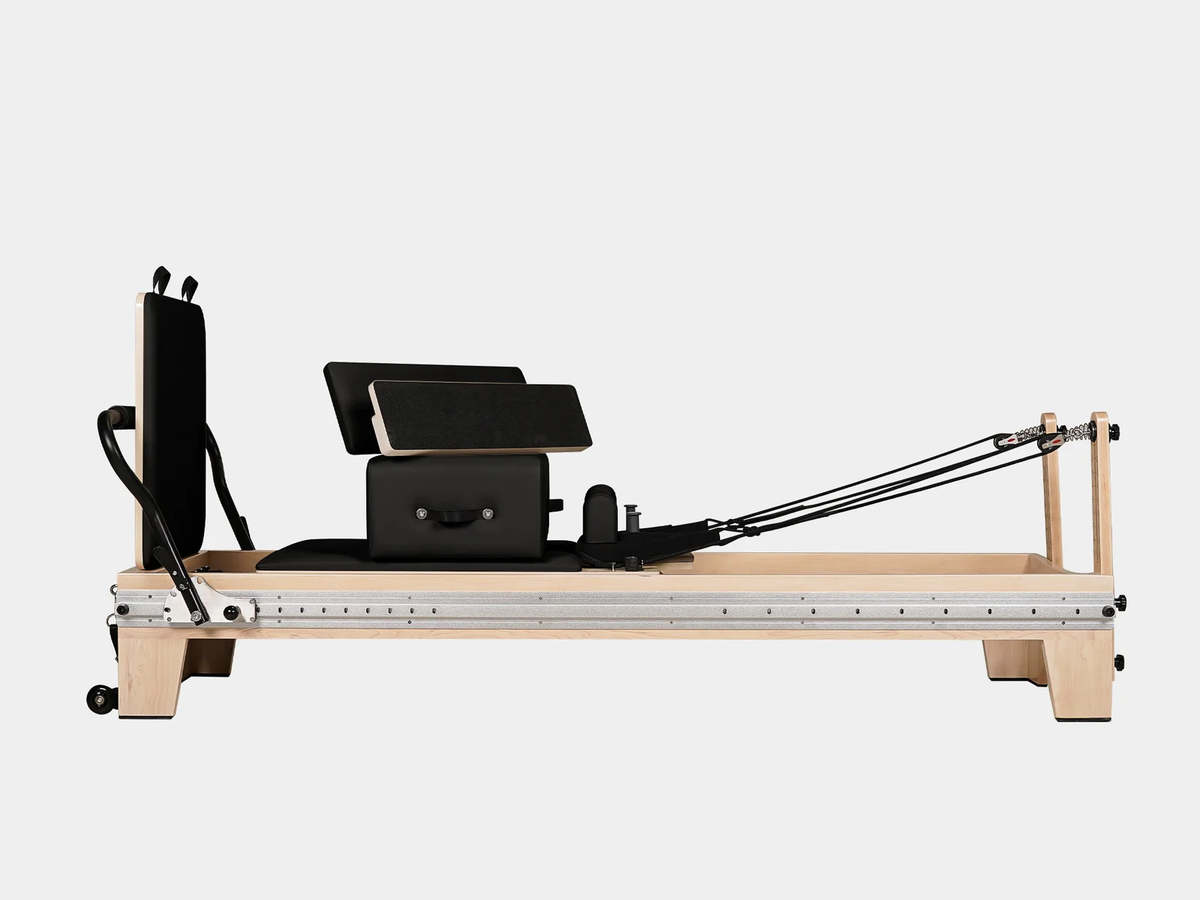
When selecting a Pilates Reformer for your Pilates studio, the frame material not only affects the equipment’s appearance but also influences surface durability, daily maintenance, and the overall aesthetic of your training space.
Maple, particularly hard maple, is frequently used for professional Reformer frames primarily because it offers high surface hardness, a fine, uniform grain, and is well-suited for precision machining. Light-colored maple also blends more easily into bright, minimalist, and modern Pilates spaces.
However, maple wood alone does not automatically make a Reformer more stable, quieter, or better suited for commercial use. Truly professional studio equipment must also feature an appropriate frame structure, guide rails, wheel assemblies, springs, adjustment systems, and after-sales support.
Here are the key reasons studios should consider choosing a maple Reformer.
1. Hard maple offers strong resistance to surface indentations
According to commonly cited wood hardness data:
- Sugar maple is approximately 1,450 lbf;
- American white oak is approximately 1,360 lbf;
- Northern red oak is approximately 1,290 lbf.
These figures indicate that sugar maple resists surface indentations better than the two common oak varieties mentioned above. The U.S. Hardwood Export Council also lists hardness, wear resistance, and finishability as key characteristics of American hard maple.
For studios that serve different members every day, strong resistance to surface indentations reduces the risk of visible marks resulting from:
- Accessories and tools colliding with the frame;
- Adjusting or moving equipment;
- Contact with hard objects such as shoe buckles;
- Frequent cleaning and wiping;
- Extended, rotating use by multiple members.
However, the Janka hardness test measures a wood’s resistance to surface indentation, not the finished Reformer’s rated weight capacity or structural strength.
The commonly cited value of 1,450 lbf specifically corresponds to sugar maple and cannot be automatically applied to all finished equipment labeled simply as “maple” or “North American hard maple.”
2. Fine Grain Suitable for Precision Frame Machining
Hard maple typically features a fine, uniform, and relatively straight grain, making it suitable for cutting, drilling, sanding, and surface finishing.
For studios, these characteristics offer several practical advantages:
- Frame edges and corners are better suited for detailed machining;
- Sanding results in a smoother texture;
- It is easier to maintain consistent color and grain across multiple pieces of furniture;
- Light-colored surfaces minimize the distraction caused by overly prominent wood grain in interior design;
- After proper sealing, the surface is easier to wipe clean on a daily basis.
It is important to note that a fine, dense grain enhances the finish quality of the frame surface but does not directly determine the smoothness of the pulley system. The pulley experience still depends primarily on the guide rails, wheel assemblies, bearings, and assembly precision.
3. Light-Colored Maple Blends More Easily into Modern Studio Designs
A Pilates studio is not just a training space; the equipment is also part of the overall brand experience.
Maple typically ranges in color from creamy white to light brown, with a relatively subtle grain, allowing it to blend naturally with the following design elements:
- White or light-colored walls;
- Abundant natural light;
- Light-colored wood flooring;
- Minimalist or modern decor;
- A brand aesthetic that emphasizes cleanliness, tranquility, and professionalism.
If you need to place multiple Reformers in the same studio, light-colored maple typically creates a neater, more unified visual effect than woods with stronger grain patterns.
Oak, on the other hand, has a more pronounced natural grain and a distinct furniture-like quality, making it better suited for studios with a warm, classic, or vintage style. Therefore, there is no absolute superiority or inferiority when it comes to wood finishes; the key lies in whether it aligns with your brand positioning.
4. Maple frames can be used in various class configurations
“Maple Reformer” does not mean there is only one type of structure.
Depending on your class curriculum and space layout, maple frames can be combined with fixed, foldable, full-track, or Tower configurations.
This means you don’t have to make a simple trade-off between “liking the look of maple” and “needing specific functionality.” A more sensible approach is to first determine your class needs and then select the appropriate structure.
Limited space requires freeing up floor area after class
The BR Maple Foldable Pilates Reformer features a North American hard maple frame and a hydraulically assisted folding system.
Current specifications include:
- Unfolded dimensions: 2370 × 690 × 580 mm;
- Folded dimensions: 1200 × 690 × 470 mm;
- Net weight: 68 kg;
- Maximum user weight: 150 kg;
- Equipped with 6 springs;
- Available in two bed heights: 29 cm and 35 cm.
It is suitable for studios that need to adjust their floor layout between different classes. However, at 68 kg, it is not a lightweight piece of equipment suitable for frequent transport between floors; you will still need to plan your moving routes and storage locations in advance.
For those looking to establish a permanent Reformer teaching area
The BR Maple Pilates Reformer features a fixed hard maple frame.
Current specifications include:
- Dimensions: 2450 × 770 × 996 mm;
- Net weight: 78 kg;
- Maximum user weight: 200 kg;
- Equipped with 6 springs;
- Features aluminum alloy guide rails and PU pulley wheels.
If your studio does not need to store the equipment daily and you wish to maintain a fixed training layout between private and group classes, you may want to prioritize this model for comparison.
Requires a higher maximum user weight
The BR Full Track Maple Pilates Reformer features a maple frame and a full-track design.
Current specifications include:
- Dimensions: 2413 × 718 × 996 mm;
- Net weight: 78 kg;
- Maximum user weight: 227 kg;
- Features reinforced stainless steel guide rails;
- Equipped with PU pulley wheels.
Among the maple Reformers currently being compared, this model has the highest maximum user weight. If your studio needs to accommodate members of different body types, you may want to further compare its pulley travel, adjustment range, and suitability for various classes.
Classes Requiring Tower Exercises
The Maple Pilates Reformer With Tower features a North American hard maple frame and integrates Reformer and Tower training into a single unit.
Current specifications include:
- Dimensions: 2460 × 740 × 2080 mm;
- Net weight: 110 kg;
- Maximum user weight: 200 kg;
- Equipped with 6 Reformer springs;
- Equipped with 8 Tower springs.
If your class curriculum includes Tower exercises, this unit eliminates the need for a separate Tower. However, you’ll need to verify your studio’s ceiling height, equipment spacing, and instructor movement space in advance.
You may also want to first understand the differences between the Reformer and the Reformer with Tower.
5. Wood Is Only Part of the Story When It Comes to Stability and Quiet Operation
While the maple frame may contribute to vibration transmission throughout the machine, the stability you feel during training and the operational noise you hear are also influenced by the following components:
- Guide rail material and straightness;
- Pulley wheels and bearings;
- Springs and hooks;
- Cables and pulleys;
- Frame joints and fasteners;
- Base feet and floor leveling;
- Installation and ongoing maintenance.
In our maple series, some models feature aluminum alloy or stainless steel guide rails and PU pulley wheels, designed to help pulleys run smoothly and minimize mechanical noise.
If quiet operation is particularly important for your studio, pay close attention to the following:
- Whether the pulleys glide smoothly when extended slowly;
- Whether there is any impact or jerking during the return stroke;
- Whether the springs produce a noticeable metallic sound when switching;
- Whether the frame makes unusual noises when using the jump board;
- Whether the wheel assemblies, guide rails, and springs are easy to inspect and replace.
Therefore, it is not recommended to assume that a piece of equipment will necessarily be quieter simply because “maple wood has vibration-damping properties.” The wood, guide rails, wheel assemblies, and assembly must be evaluated as a complete system.
6. Wood Drying and Surface Treatment Affect Long-Term Condition
All solid wood absorbs or releases moisture in response to changes in ambient temperature and humidity.
Proper wood drying helps reduce the risk of subsequent shrinkage, expansion, and warping in the frame; an appropriate surface finish can minimize the effects of sweat, cleaning agents, and brief exposure to moisture on the wood’s surface.
However, neither kiln drying nor surface finishing can guarantee that the wood will never undergo dimensional changes.
If your studio is located in an area with significant fluctuations in humidity, you should confirm the following before purchasing:
- The required moisture content at the time of wood assembly;
- The surface finish to be used on the frame;
- How joints and wood ends will be treated;
- Which cleaning agents can be used;
- Methods for repairing surface damage;
- Recommended indoor temperature and humidity ranges.
If wood species, grade, origin, or surface treatment are part of your project’s procurement criteria, please contact us before placing an order to verify the current production specifications for the model.
7. Solid wood is not necessarily superior to laminated or joined structures
“Solid wood” may sound more intuitive, but it does not automatically mean it is more stable or durable.
A well-designed laminated structure can minimize the impact of wood expansion and contraction on the component by adjusting the grain direction of adjacent layers. High-quality finger-jointed or glued structures can also deliver reliable performance when properly designed and manufactured with the right adhesives and quality control.
When selecting a wooden-framed Reformer, you can further verify:
- Which parts of the frame use solid wood;
- Whether laminated, finger-jointed, or veneered structures are used;
- What type of joints are used;
- How the wood grain is oriented;
- Whether the frame and joints are covered by the warranty.
Similarly, FAS is a clear-cut yield grade for hardwood lumber; it does not represent the structural strength or safety certification of the finished Reformer. You can refer to the NHLA Hardwood Grading Rules for relevant definitions.
8. What else should a studio check when purchasing a maple Reformer?
Even if you have decided on a maple frame, it is still recommended to confirm the following information before placing an order:
- The specific type of maple used.
- Whether the frame is made of solid wood, laminated, or another construction method.
- The finished dimensions, net weight, and maximum user weight.
- The configuration of the rails, wheel assemblies, springs, and pulleys.
- Whether it is suitable for your class types and the height range of your members.
- Whether commercial studio use is covered under the warranty.
- Whether springs, wheel assemblies, cables, and padding are considered wear-and-tear parts.
- Whether commonly used spare parts are in stock and their estimated delivery times.
- Whether color and configuration matching is available for bulk purchases.
- Who is responsible for unloading, moving in, and installation.
According to our shipping policy, large equipment is typically shipped via freight and delivered curbside. You’ll need to verify door widths, elevators, stairwells, and turning spaces in advance, and arrange for sufficient personnel to complete unloading and indoor transport.
Once in use, you can refer to our Wooden Pilates Reformer Maintenance Guide to establish a schedule for cleaning, fastener inspections, rail maintenance, and replacement of wear-and-tear parts.
Is maple definitely a better choice for a studio than oak?
Not necessarily.
Hard maple is better suited for studios that prioritize a light, modern appearance, a fine grain, and surface resistance to dents. Oak, on the other hand, is better suited for spaces that prefer a distinct wood grain, warm tones, and a classic furniture aesthetic.
Both types of wood can be used for professional Reformers. Final performance depends on the specific wood species, frame design, joint construction, guide rails, wheel assemblies, springs, and maintenance—not the name of the wood itself.
If you’re still deciding between a wooden frame and a metal frame, continue reading our comparison guide on wooden versus metal Pilates Reformers.
Why Do Studios Ultimately Choose Maple Reformers?
Maple Reformers meet many studios’ requirements for both equipment aesthetics and practical use:
Strong resistance to surface indentations;
Fine, uniform natural grain;
Suitable for fine sanding and surface finishing;
Helps create a bright, modern studio aesthetic;
Compatible with fixed, folding, full-track, and Tower configurations.
However, the right equipment for a studio cannot be determined solely by the “maple wood” label. You’ll also need to compare the overall structure, suitability for classes, maximum user weight, guide rail systems, warranty, spare parts, and delivery terms.
You can browse our maple Reformer series to select the model that best fits your space, class offerings, and configuration requirements.
If you’re planning to purchase multiple units, need custom colors, or wish to confirm current material specifications, please contact BuyReformer.
Share:
Advantages of Using Maple Wood to Manufacture Pilates Reformers
The Best Maple Wood Reformers for Beginners